How do Indians use their gold loans?

http://www.developmentoutlook.org/2013/09/how-do-indians-use-their-gold-loans.html
In our
previous post we spoke about why Indians buy gold. Citing another important
finding from our gold-loan study, we highlight the various
purposes for acquiring gold loans in this post.
According to
the revised norms of Microfinance Institutions (Development and Regulation)
Bill, microfinance clients are required to use 70% of their loans for income
generating activities or productive purposes [1]. This guideline has been extensively debated among policy makers and microfinance
practitioners since there's no clear demarcation between productive and
non-productive purposes. For example, expenditure on health/education is not
considered as an income generating activity but it could be categorized as a productive purpose because good education/ good health improves one's productive
capacity, making the expense an investment in human capital.
However, the gold loan market does not impose any
restrictions on the usage of loans. Therefore, it is interesting to analyze if
poor people use gold loan for productive or non- productive purposes in the
absence of a borrowing constraint. This study attempts to investigate various
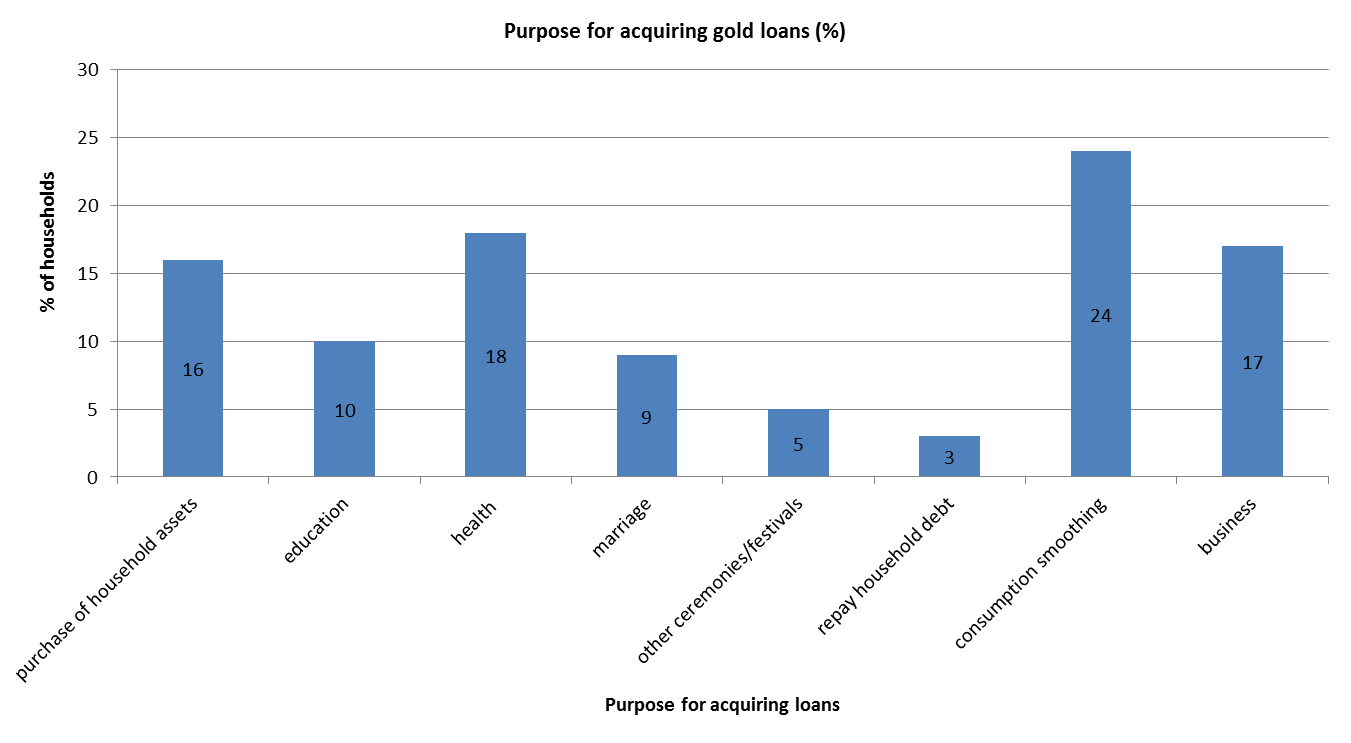
purposes for which clients acquire gold loans and finds that 24% of the clients
mentioned consumption smoothing as the primary reason for taking gold loans.
Most low-income households do not have a stable path of consumption due to the nature of their employment resulting in a lack
of regular income. The second leading category is health as 18% of respondents acquired gold loans for expenditure on health, followed by a close 17% for business expenditure, which involves smoothing cash flow problems,
repaying old business debt, investment for innovation in the business, etc. Other
reasons include purchase of household assets (16%), education (10%) and marriage
(9%).
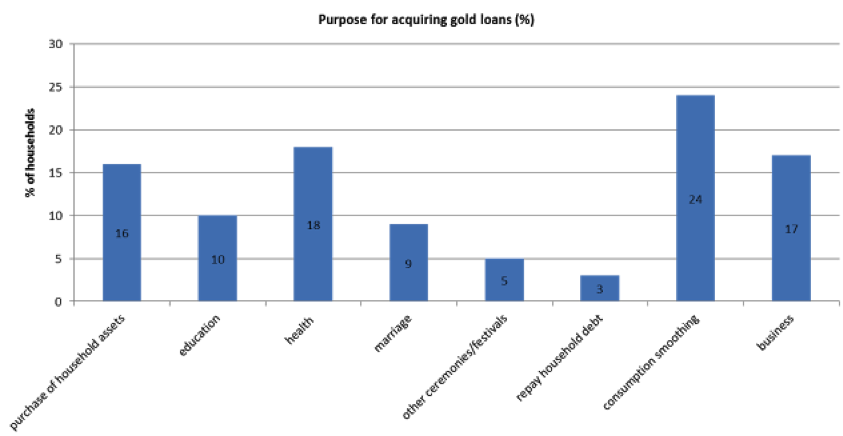 |
| Figure 1. Purpose for acquiring gold loans |
To dig deeper into our research question, we try to see various reasons for
acquiring a gold loans per loan type. In other
words, does the source of the loan vary depending on the reasons for obtaining a
gold loan? Referring to figure 2, we observe that, for instance, 50% of gold
loans for health purposes are acquired from private money lenders. Similarly,
60% of loans for consumption smoothing purposes are obtained from private money
lenders. On the other hand, more than 55% of loans for purchase of household
assets and approximately 45% of loans for education are obtained from commercial
banks. These findings have an important implication. The results lead us to
believe that clients prefer approaching informal institutions for short term or
emergency needs but prefer formal institutions when it comes to other
specialized loan products such as home or bank loans. Since formal players
are relatively new to the gold loan market, there is definitely scope for
innovation and scale, in order to provide a wider array of
choices to low-income households.
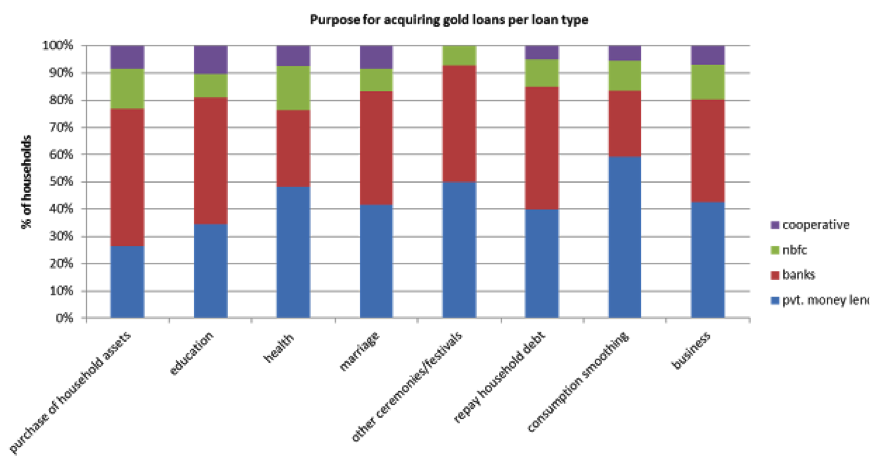 |
| Figure 2. Purpose for acquiring gold loans per loan type |
Going
by our data, it would be safe to say that gold loans are mostly used for
productive purposes, if not for an income generation activity per se. Investing
in health, education and business, which comprises of 45% of the total
expenditure via gold loans, can certainly be classified under productive
purposes and thus signifies the importance of gold loans as an alternative to
cater to the needs of the bottom of the pyramid. With formal organizations
emerging in the gold loan domain, the future definitely seems bright for gold
loan clients.
Recommended Reading:
1. RBI Report, Study of issues related to gold imports and gold loans by NBFCs, 2013
2. Cognizant 20-20 Insights, Surveying the Indian Gold loan market, 2012
3. Livemint, RBI norms on gold imports may deal a blow to domestic jewellers, 2013
Recommended Reading:
1. RBI Report, Study of issues related to gold imports and gold loans by NBFCs, 2013
2. Cognizant 20-20 Insights, Surveying the Indian Gold loan market, 2012
3. Livemint, RBI norms on gold imports may deal a blow to domestic jewellers, 2013


Excellent insights!
ReplyDeleteThanks for sharing your findings Misha. The article not only highlights the importance of Gold/Jewel loan as a product but also sheds light on preference in source of availing this loan based on the actual purpose!!!
ReplyDeleteThe reason for preference for Private Moneylenders for short term needs could be due to smaller amounts and hence lesser total payout and also the ease of availing the loan.
Since commercial banks charge lower interest rates and generally offer longer term loans, customers might prefer those to meet their needs.
Analysis on loan size vis-a-vis their source could also throw good light.
Hi Rohit. Thanks for your comments. There definitely seems to be a market niche that the organized and unorganized gold loan sector have created for themselves, when it comes to availing gold loan for different needs. There is a huge potential for growth for the organized sector, as it currently captures only 25% of the market share.
ReplyDeleteWe also have data that compares loan size with different financial sources and we shall present those results in our next blog. Thanks for reading!
There are various financial products business loans that may advantage a business providing terms tend to be fulfilled as well as the enterprise just isn't battling.
ReplyDeleteWhatever might be the reasons till date, in the recent generation all the people are buying gold and taking loans as per their need? The government is even starting many schemes which are useful for the people as they are in turn getting interests on those gold investments. The only thing is one must know to what extent are people willing to invest.
ReplyDeleteWhatever might be the reasons till date, in the recent generation all the people are buying gold and taking loans as per their need? The government is even starting many schemes which are useful for the people as they are in turn getting interests on those gold investments. The only thing is one must know to what extent are people willing to invest.
ReplyDelete