
MFIs: Creating Slaves to Microfinance or Becoming the Saviors?
http://www.developmentoutlook.org/2013/02/mfis-creating-slaves-to-microfinance-or.html
Author: Surabhi Agrawal
With an even-fisted force in the
air, he yells, “We are not a slave to your microfinance!” and storms off to the
back of the house, leaving twenty-three clients, one collection officer, and
two surveyors in a small room shyly looking at each other. The group leader,
the wife of the angry gentlemen who believed we had invaded his house, stated
that her husband was frustrated with the weekly meetings held by the Microfinance
Institution (MFI). “He feels our work is disrupted weekly because we have to gather
for the meeting.”
If we leave the story here, then
this will become another example to be cataloged in the literature of how
capitalist are imposing their microfinance, making clients ‘slaves’ in debt
with various imposing conditions. But a different chord will be struck as you
enter another household for a collection meeting and a woman begins to show
case her new sewing machine along with a sample of household handicraft items
she has made. “I learned how to design these at a workshop held four months ago
at the branch office.” With a shining face, she shows the repairs she made to a
window in the house from the profits.
These scenarios, as nerving or
heart-warming, take us to the original debate - “Does microfinance perpetuate women
in a cycle of debt or does it help lift women out of poverty?” Much research
has been conducted on this topic, with ardent supporters of both schools. CMF-IFMR
has undertaken a study in partnership with Columbia University Business School
where we are approaching this topic with a different angle: What are the
sources and best management practices for high productivity for MFIs? Along
with the financial services, if the MFI provides any social services, then what
are the performance outcomes?
The study is being conducted across
six states in India (Uttar Pradesh, Madya Pradesh, West Bengal, Maharashtra
Tamil Nadu and Kerala) with 19 partner MFI organizations. Through surveys,
fieldwork observations, and focus-group discussions, we are understanding the
perspectives of branch managers, loan officer, and clients. We are also
interviewing senior management in operations and human resources, along with
collecting particular branch level financial data for the past two years. Yes,
we are covering all four corners of the country. Yes, we are working with a
large segment of the sector, some of which started as grassroots NGOs and some
which are the largest players in the industry. And yes, we are compiling a very
large and detailed database, a unique undertaking at such a critical time for
the industry.
So how are management practices
going to answer the original question? Mandatory attendance policy? Weekly
meetings? Socially-geared workshop? These are all elements of the management policies and practices the
MFI has put into place. For example, how does the recollection frequency
structure effect repayment rates? How effective are social program in terms of
client retention, repayments, and capacity-building? As fieldwork has
completed, questions like these and many more will soon be analysed, providing
critical insights to the industry at a moment when the RBI is devising new
policies and legislature is debating where to place this sector in the complex
world of finance.
So before we jump to any conclusions, we should rethink the question, what exactly determines the successes and failures of microfinance?
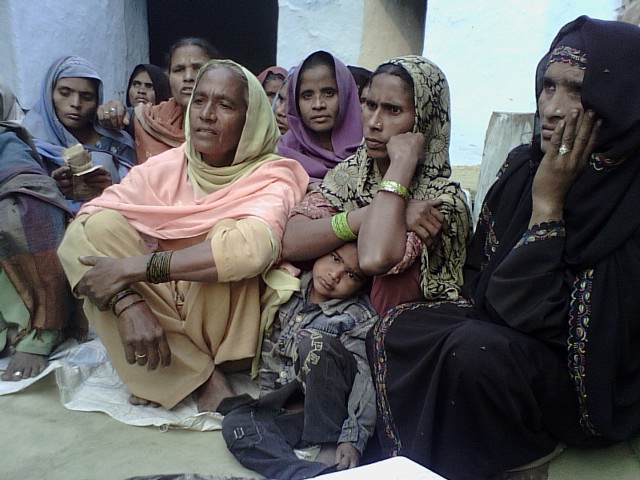 |
| Women gathered for MFI Meeting (Photo courtesy of Pramod Tiwari) |


