History of Agricultural Credit in India - Timeline

http://www.developmentoutlook.org/2013/02/history-of-agricultural-credit-in-india.html
Development of rural credit
systems have always been a complicated affair and this is clear from India's history. Intermittent
failure of monsoons, unscientific farming practices and rural indebtedness, seasonal
need for credit and other risks has ensured that high interest rates remain a
norm rather than an exception with respect to credit. This problem was also noticed by our colonial
masters and to this date, providing a formal system of credit seems to be a
challenge. What I have done here in this post is an attempt to develop a
timeline based on an article I came across online. This will be the first among
many posts that I intend to write on agricultural credit and I am open to feedback on the same.
1870 - British administration began to notice the problems in
Indian agriculture
1904 - Cooperative Societies Act àCooperatives seen as premier institutions
for disbursing agri-credit.
1912 - Continuous official attention à provision of rural credit.
New Act passed in 1912 à
gave legal recognition to credit societies
1915 - Maclagan Committee - advocated establishment of
provincial coop banks - by 1930 all provinces had them à Rise of 3-tier cooperative
credit structure
1926-27 - Royal Commission on Agriculture further examined
rural credit
1934 - Reserve Bank of India Act 1934 - specific provision
for attention to agri-credit
1935 - Sir Malcolm Darling submitted a report on cooperative
credit to GoI. Sec 54 - RBI to set up an Agricultural Credit Dept - expert
staff à
advise central and state govts, state coop banks, co-ordinate RBI functions for
agricultural credit
1936-37 - 1st activities - Studies in 1936 and 1937 ->
found that entire finance required by agriculturalists supplied by
moneylenders, coop and other agencies were negligible
1935-1950 à
RBI strongly promoted coop cred movement, building a cooperative cred structure
à 2 separate arms, one
for short-term and one for long-term (exists even today)
1945-1950 - over half a dozen committees appointed to study
the progress of provision of rural credit
1951 - Provision of credit via coop only 3.3% of
cultivators, via commercial banks only 0.9%. Moneylenders charged high interest
rates. Legislation on moneylending was advocated to chk malpractices
1954 - Report of All India Rural Credit Survey - foundation
laid for building a broader credit structure. Apart from visualising coop as an
exclusive agency for provision credit to agriculture, recommended setting up of
SBI and using it to extend commercial banking facilities to rural and
semi-urban areas
1963 - Agricultural Refinance Corporation set up to provide
funds by means of refinance, in vain. Inadequacy of rural credit was a concern
even in 50s and 60s
1965-67 - Drought brought some attention back to agriculture
when country was focused on industrial growth
1966 - All India Rural Credit Review Committee formed in
July to review supply of rural credit in context of 4th Five-Year plan, asked
to make recommendations to improve flow of agri-credit. Commercial banks
advised to play a complementary role to cooperatives
1969 - Social control and nationalisation of commercial
banks (1969 and then 1980) played catalyst role to efforts of leveraging the bank
system for extending agri-credit. Concept of priority sector was introduced to
help neglected sectors like agriculture
1975 - Decent credit planning through Lead Bank Scheme, each
district was placed with a commercial bank to spearhead cred allocation for
agri-lending; ARC was renamed as Agricultural Refinance and Development
Corporation (ARDC)
60s and 70s - Green revolution in the late 60s and 70s did
necessitate adequate availability of credit. However, flow of credit still was
not improved -> comm banks were not tuned to needs and requirements of small
and marginal farmers
1977 - Setting up of a separate structure capable of combining local feel of coop and large resource base of comm banks. Recommendation from Narasimham Committee in 1975, Regional Rural Banks or RRBs were set
1982 - Following the recommendations of the “Committee to
Review Arrangements for Institutional Credit for Agriculture and Rural
Development”, the National Bank for Agriculture and Rural Development (NABARD)
was set up in 1982
1991 - Report of Committee on Financial System 1991 provided
blueprint for carrying out overall fin sector reforms during 1990s. Weaknesses
in performance of rural fin institutions since 1991resulted in setting up of various
committees/task forces to look into operations
- “The High-level Committee on Agricultural Credit through Commercial Banks” (RV Gupta, 1998)
- “Task Force to Study the Functions of Cooperative Credit System and to Suggest Measures for its Strengthening” (Jagdish Capoor, 1999) -> adoption of a Model Cooperative Act, setting up of a Coop rehab and development fund at NABARD et Mutual Assistance Fund at State Level
- “Expert Committee on Rural Credit” (V.S. Vyas, 2001) -> restoration of health of Primary Agricultural Credit Societies (PACs) by scrapping the cadre system, selective delayering of cooperatives credit structure and integration of short and long-term structures.
- “The Working Group to Suggest Amendments in the Regional Rural Banks Act, 1976” (M.V.S. Chalapathi Rao, 2002) -> suggesting diversification of the business of RRBs, recommended introduction of capital adequacy norms for RRBs in a phased manner, along with the RRB-specific amount of equity based on the risk-weighted assets ratio
1995-96 - RIDF or Rural Infrastructure Development Fund set
up in 1995-96. NABARD has major catalytic role in micro-credit movement through
SHGs. However on the eve of 1991 reforms, rural credit delivery system was in a
poor shape
POST 1991 Summary
- Deregulation of interest rates of co-operatives and RRBs
- Deregulation of lending rates of commercial banks for loans above Rs. 2 lakh
- Recapitalisation of select RRBs
- Introduction of prudential accounting norms and provisioning requirements for all rural credit agencies
- Increased refinance support from RBI and capital contribution to NABARD
- Constitution of the Rural Infrastructure Development Fund (RIDF) in NABARD for infrastructure projects
- Introduction of Kissan Credit Card (KCC) and stipulation of interest rate not exceeding 9 per cent for crop loans up to Rs.50,000 extended by the public sector banks.
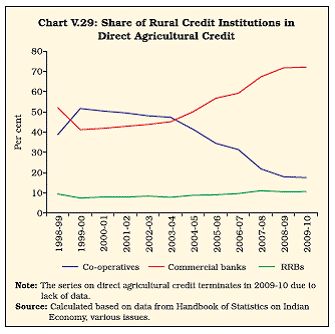 |
| Photo Credit: Reserve Bank of India |
It does not look like we have seen the end or will witness
any decline in the kind of innovation that will be used to tackle the
challenges we face as far as credit is considered in the Indian agricultural
context. Though the problem is far from solved, we have come a long way. An interesting
point to note is that ‘Agricultural credit’ or the lack of it has indirectly or
directly played a role in the setting up of RBI, SBI and NABARD.


