Revitalizing the Self-Help Group Movement in India

http://www.developmentoutlook.org/2016/06/revitalizing-self-help-group-movement.html
Growth of the self-help group movement in India has slowed in the past five years. How can challenges be overcome to improve and revitalize these programs? In this article, Misha Sharma and Shreya Chatterjee from our research team highlight findings from the midline evaluation of the Hand-in-Hand Self-Help Group Programme in Tamil Nadu - one of the first rigorous evaluations of the socio-economic impact of self-help groups on the lives of participating women.
Despite early success, however, the growth of SBLP has slowed in the last five years. Several factors have contributed to the deceleration. The microfinance crisis in 2010 led to the perception of self-help group being inextricably linked with the development of the microfinance program. NABARD too acknowledged issues of regional imbalance, less than ideal average loan size, lack of monitoring and training support by self-help group federations, delays in opening bank accounts, impounding of self-help group savings by banks as collateral, and escalating non-performing assets of self-help group loans with banks. Several studies have also found that self-help groups grapple with issues related to governance, quality, transparency and irregularity in their functions.
The Evidence
An ongoing study at IFMR LEAD focuses on understanding these challenges better, along with evaluating the role that self-help groups play in uplifting the livelihoods of people in rural areas. It is one of the first rigorous studies in India that evaluates the impact of self-help groups on the livelihoods of rural poor.
To read the full text of the article, please click here
This article first appeared on the Consultative Group to
Assist the Poor (CGAP)
Blog.
The
self-help group movement in India began in the 1980s when several NGOs
mobilized and organized poor communities in rural areas to provide formal
channels for social and financial support. The program gained momentum with the National
Bank for Agriculture and Rural Development (NABARD) linking a
small number of groups with banks. Called
the Self-Help Group Bank Linkage Program (SBLP), the
revolutionary initiative connected group members - many of whom had never had a
bank account before - to formal financial services in a sustainable and
scalable manner.
As of 2014, over 4.19 million self-help groups had
outstanding bank loans and 7.42 million had savings accounts with banks under the SBLP. Over the last two
decades, the SBLP has proven to be a great medium for social and economic
empowerment for rural women. Today, these self-help groups are seen as more
than just a conduit for credit - they also act as a delivery mechanism for
various other services ranging from entrepreneurial training, livelihood
promotion activity and community development programs.
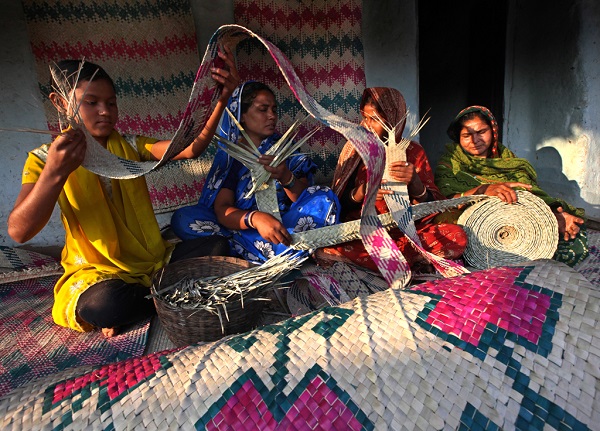 |
| Photo Credit: Somenath Mukhopadhyay, 2012 CGAP Photo Contest |
The Evidence
An ongoing study at IFMR LEAD focuses on understanding these challenges better, along with evaluating the role that self-help groups play in uplifting the livelihoods of people in rural areas. It is one of the first rigorous studies in India that evaluates the impact of self-help groups on the livelihoods of rural poor.
To read the full text of the article, please click here


