Assisted models of Digital Finance - a Stepping Stone?

http://www.developmentoutlook.org/2016/06/assisted-models-of-digital-finance.html
This is the second article in a series on the progress of digital financial services in Bangladesh. It draws on discussions held at a recent seminar on the subject, organized by BRAC’s Social Innovation Lab in Dhaka, in collaboration with a2i, and USAID’s mSTAR project implemented by FHI 360. IFMR LEAD was the Knowledge Partner for the event.
In the first part of this series, we highlighted gender gaps in access to mobile financial services and their usage among women in Bangladesh. In this article, we take a look at assisted models of digital finance such as over-the-counter transactions, and the reasons why they may be here to stay in the near future.
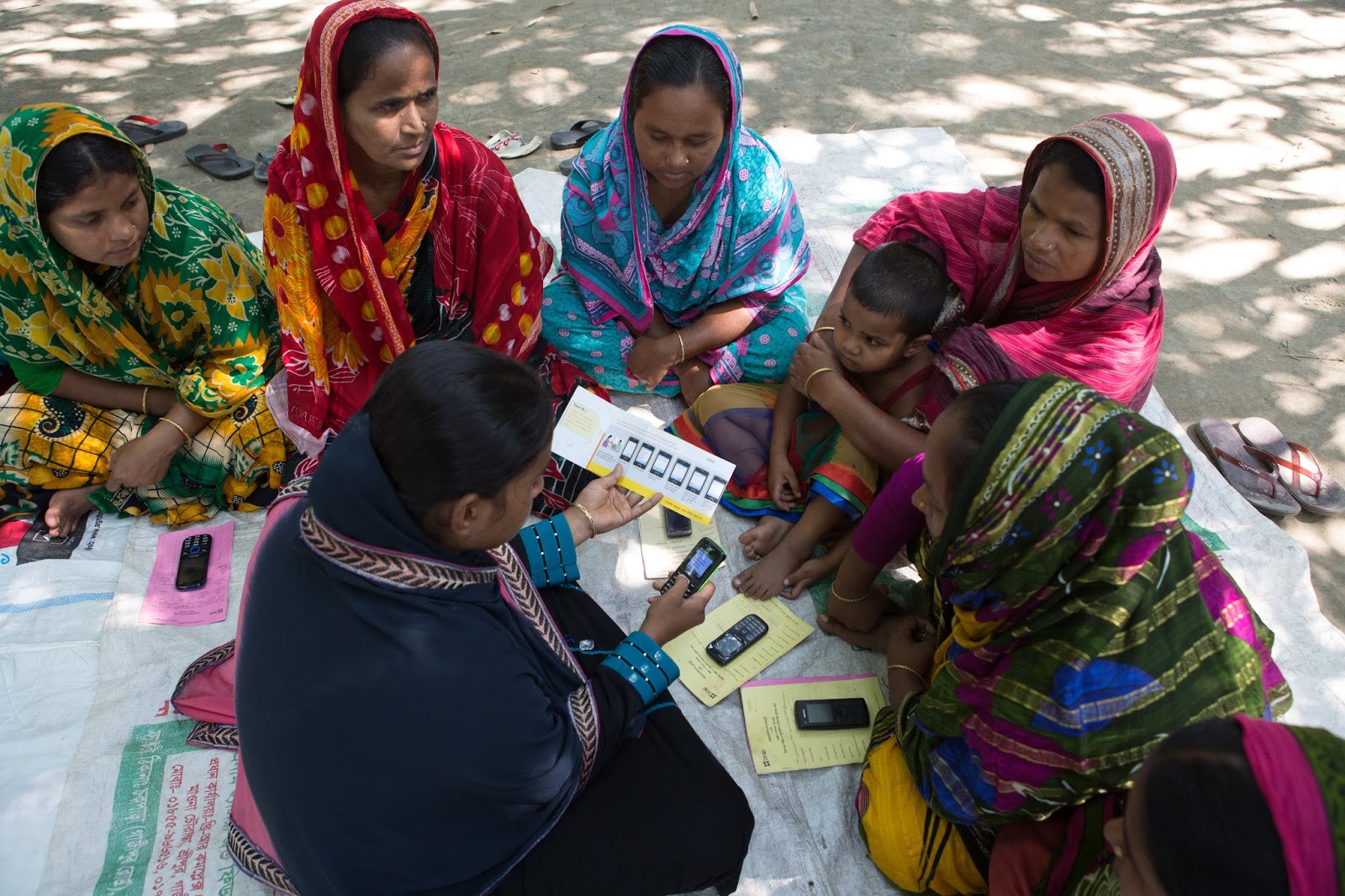 |
Image Courtesy: BRAC
|
The digital financial services (DFS) revolution
is upon us, and the DFS landscape is a fast moving and exciting space. In South
Asia, Bangladesh is at the forefront of the revolution. Having been a pioneer in the microfinance
revolution, Bangladesh is now leading the way forward in bringing digital, and
particularly mobile financial services (MFS) to the poorest of the poor. Many
champion MFS as the way forward, to include those traditionally
left out from the scope of formal financial services. In a recent interview,
Bill Gates, had this to say:
“Banking is more fundamental than I realised. There have been attempts: the microfinance groups, co-operatives, but the transaction fees have always been too high. Until we get those services down with very low fees onto the cellphone in digital mode then banking will always be for those who are better off”.
However, at present, accessing these mobile
phone based services, often mobile wallet-based, is challenging for the poorest
sections who constitute the base of the pyramid (BoP) segment. Assisted models
of these services currently dominate the market. Many users prefer to rely on
“Over the counter” (OTC) transactions due to a lack of familiarity with the
technology, and low financial literacy. Additionally, OTC happens to be a
simple solution for domestic transfer for non-regular users. As this blogpost by CGAP
summarizes,
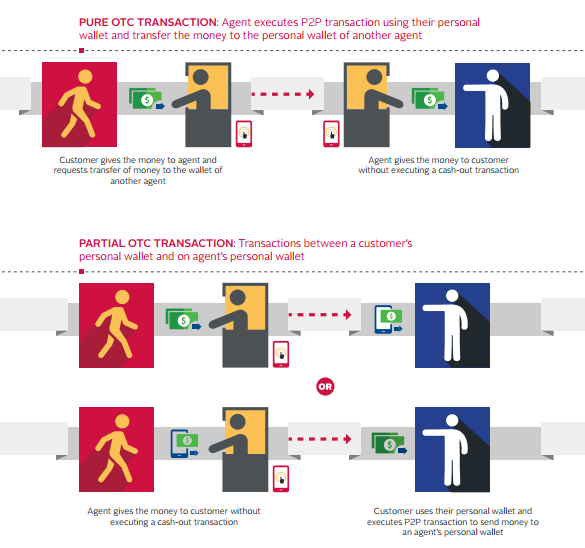
“In Bangladesh, over-the-counter (OTC) transactions usually happen as a person-to-person transfer arranged between a sender and receiver. The sender and receiver each use an agent to complete the electronic transaction. The two agents involved can make these transactions happen in a variety of technical combinations (most often as cash-in transfer of value to an account or a cash-out from an account).”
Types of OTC Transactions1
 |
The significant number of OTC and other agent-led
transactions happening are being considered a cause of concern for the
Bangladesh government and the Central Bank, because the potential drawbacks of
such transactions are many. Involving agents in e-transactions between
individuals - particularly those with lower levels of literacy - makes their
exploitation all the more possible. At the same time, it raises the risk of
fraud and susceptibility of agents to operational risks such as theft and data
leakages. From a regulator’s point of view as well, OTC transactions can pose serious
challenges, which is why the central bank has put in place strict regulations
concerning OTC transactions. A primeconcern pertains to the
susceptibility of these transactions to misuse, for illegal purposes such as
money laundering. Additionally, there is a fear that the persistence of OTC
transactions will hinder the transition to a digital system, since these are
definitely more convenient for a section of society - leading to a kind of
lock-in.
From a financial inclusion point of view
however, the prevalence of OTC and similar types of transactions represents an
important stepping stone in the leap from traditional channels of accessing
financial services to embracing digital, and mobile phone based services. For
one, it allows the inclusion of a large set of people into the system immediately,
who would not have been included otherwise. While difficult to quantify, one estimate
suggests that of the 24.7 million Bangladeshi adults who have used bKash at
least once, the number of implied (and unique) bKash OTC users could be as high
as 19.7 million! This is not a small number, and it reminds us that while a
digital service like bKash has had a tremendous impact, it is not easy -
particularly for the BoP segment - to transition to a completely digital system
without significant handholding and guidance. The human touch goes a long way
in this regard. Additionally, the assumption that is dependent on the human
touch will impede the transition to a completely digital system, discounts the
power of peer learning among users. As more people perceive the ease, benefits
and upsides to using digital and wallet-based systems, their popularity is
likely to increase.
While concerns regarding people being cheated
or taken advantage of with reference to OTC type transactions may be legitimate,
anecdotal evidence shows that the system is built on trust. Agents are often
locally well known, and in many cases close family members or friends are
trusted to assist OTC transactions. It would be naive to think of agent-assisted
models and fully digitalmodels as being exclusive to each other. There is
considerable value in positioning these two models as complementary to each
other - depending on the use value, for instance. Thus, policymakers and
practitioners must bear in mind the needs as well as preferences of users in
accessing different platforms of digital finance.
At
a seminar on ‘Digital financial
inclusion: Innovations from Bangladesh’ organized by BRAC recently, in collaboration with
a2i, USAID’smSTAR project implemented by FHI 360, conversations
on these issues took center-stage. While concerns that agent assisted models
would cannibalize purely digital models were played down by experts, the
advantages of using agent-assisted models as a means of hand-holding users in
the transition to a purely digital landscape were highlighted.
Ultimately, agent-assisted models can co-exist and complement purely digital
models - allowing some users to choose between them as required and as
necessary. This, many agreed, would be the way forward towards true financial
inclusion.
The authors, Parul Agarwal and Suraj Nair of IFMR LEAD, would like to thank Tanjilut Tasnuba, Maria May, and
Masrura Oishi from BRAC Social Innovation Lab and Kazi Amit Imran from FHI 360 for
their valuable inputs on this article.
__________________________________________________________


