
What does Global Findex Database 2014 tell about Financial Inclusion in India? Improved, but a long way to go...!
http://www.developmentoutlook.org/2015/04/what-does-global-findex-database-2014.html
This blog post was featured as one of the 'Top Picks of the Microfinance Blogosphere' in the Center for Financial Inclusion-Accion Blog
The World Bank’s Development Research Group ‘Global Financial Inclusion Database (Global Findex)’ has recently published its comprehensive report The Global Findex Database 2014: Measuring Financial Inclusion around the World and The 2014 Global Findex database. Good news is that between 2011 and 2014, India has fared well with regards to the number of account holders. In 2014, 53% adults are reported to have bank accounts, which is a sharp increase from 35% in 2011. What is also encouraging is that the banking penetration has drastically increased in rural areas between 2011 and 2014 (33% in 2011, 50% in 2014). However, as promising as these numbers look, unfortunately, financial inclusion goal in India is far from achieved.
1. The poor are
still excluded: Despite government’s role in establishing banks and other
infrastructure to increase the poor’s access to financial services, 56% of
those adults (% age 15+) who come under the ‘poorest 40%’ are still unbanked
(compared to 41% of those who belong to the ‘richest 60%’).
Therefore, I conclude by emphasizing that account ownership is a first step towards financial inclusion. But what really matters is whether people are actually using their accounts. The Global Findex Database highlights these gaps, and puts forth the harsh truth that India still has a long way to go to achieve the financial inclusion in a true sense.
The World Bank’s Development Research Group ‘Global Financial Inclusion Database (Global Findex)’ has recently published its comprehensive report The Global Findex Database 2014: Measuring Financial Inclusion around the World and The 2014 Global Findex database. Good news is that between 2011 and 2014, India has fared well with regards to the number of account holders. In 2014, 53% adults are reported to have bank accounts, which is a sharp increase from 35% in 2011. What is also encouraging is that the banking penetration has drastically increased in rural areas between 2011 and 2014 (33% in 2011, 50% in 2014). However, as promising as these numbers look, unfortunately, financial inclusion goal in India is far from achieved.
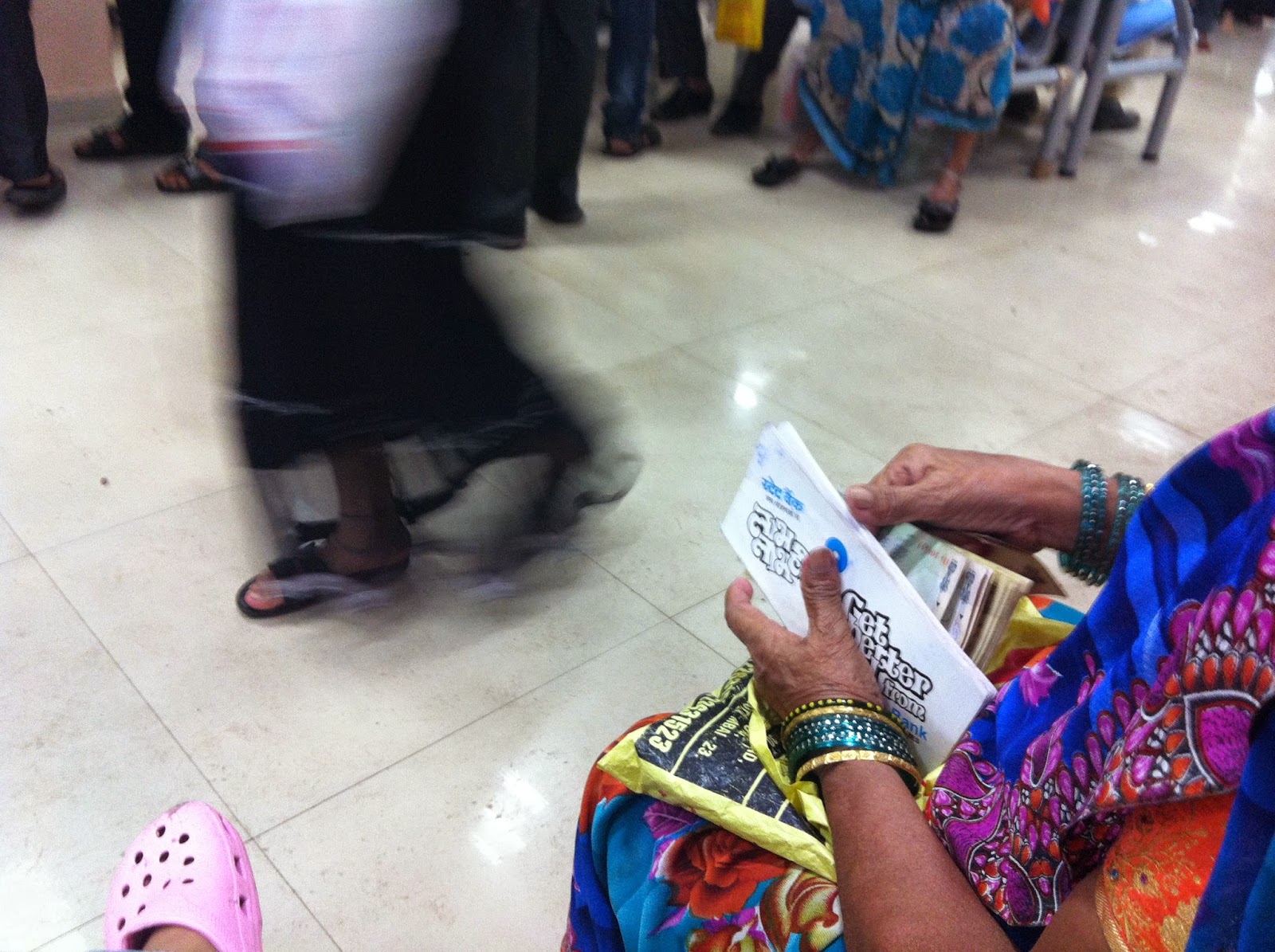 |
| Picture taken by the author in Dharavi, Mumbai |
2.
Access does
not mean usage: Many Indians have bank accounts, but they are not using them. 43%
of account holders did not
make any deposits or withdrawals in their bank accounts in the past year. 67%
of account holders reported of not making a single deposit in any typical
month. 38% of adults (% age 15+) saved in the past year; yet, only 14% saved with
formal savings accounts. 46% of adults (% age 15+)borrowed in the previous
year; but, only 6% did so from formal institutions.
3.
The power of
the informal financial sources: Many are
increasingly using informal financial services for their financial needs,
particularly when it comes to borrowing. 13% adults (% age 15+) borrowed from money
lenders; and 32% (% age 15+) from friends and relatives. Around half of adults
reported that they could raise funds during emergency; amongst these adults, only
1% could raise funds from financial institutions. 41% of such adults relied on
their informal sources, mainly their friends and family;and 35% on their own
savings.
4.
Gender
disparity in financial inclusion: More women
have bank accounts today; however, the gender gap has not narrowed. There was an 18-point difference in 2011 (44%
male and 26% female with bank accounts), and there is a 19-point difference in
2014 (62% male and 43% female with bank accounts). Financial inclusion
initiatives are usually targeted towards the general population; however, are
those messages aligning with a woman’s way of life? That is a bigger question that needs to be
answered.
5.
Cash is the predominant mode of transaction: Despite the prevalence of credit/
debit cards, mobile phones, ATMs, shop-based terminals, banking agents etc, cash
is still the king. 20% of adults (% age 15+) reported to have debit cards, and
4% credit cards. Only 11% adults used debit cards in the previous year. All
types of bills or fees were paid in cash. For example, 22% of adults paid
school fees, 99% of these adults paid in cash (6% reported of using a bank
account as well). Another example is that of paying utility bills where 39% of
adults paid utility bills, and 100% of these adults reported of paying in cash
(9% reported of using an account at a financial institution as well). Amongst
19% of adults (% age 15)who received wages in the past year, 86% received wages
in cash.
6.
Mobile banking
still a big question mark: Experts argue that we need a widespread usage of mobile
payment technology so that using electronic payments for day-to-day use becomes
easier and safer than using cash. In India, the Interbank Mobile Payment System
(IMPS) has been launched; yet, only 2% adults have mobile accounts (58% of
adults in Kenya have mobile accounts). Amongst the bank account holders, only
6% had ever made any kind of transaction from an account at a financial institution
using a mobile phone.
Therefore, I conclude by emphasizing that account ownership is a first step towards financial inclusion. But what really matters is whether people are actually using their accounts. The Global Findex Database highlights these gaps, and puts forth the harsh truth that India still has a long way to go to achieve the financial inclusion in a true sense.


