
Women’s Empowerment: The Importance of Micro Level Indicators
http://www.developmentoutlook.org/2014/11/womens-empowerment-importance-of-micro_6.html
We feature a collaborative post by
our RA's, Arpita Khanna and Monisha Mason.
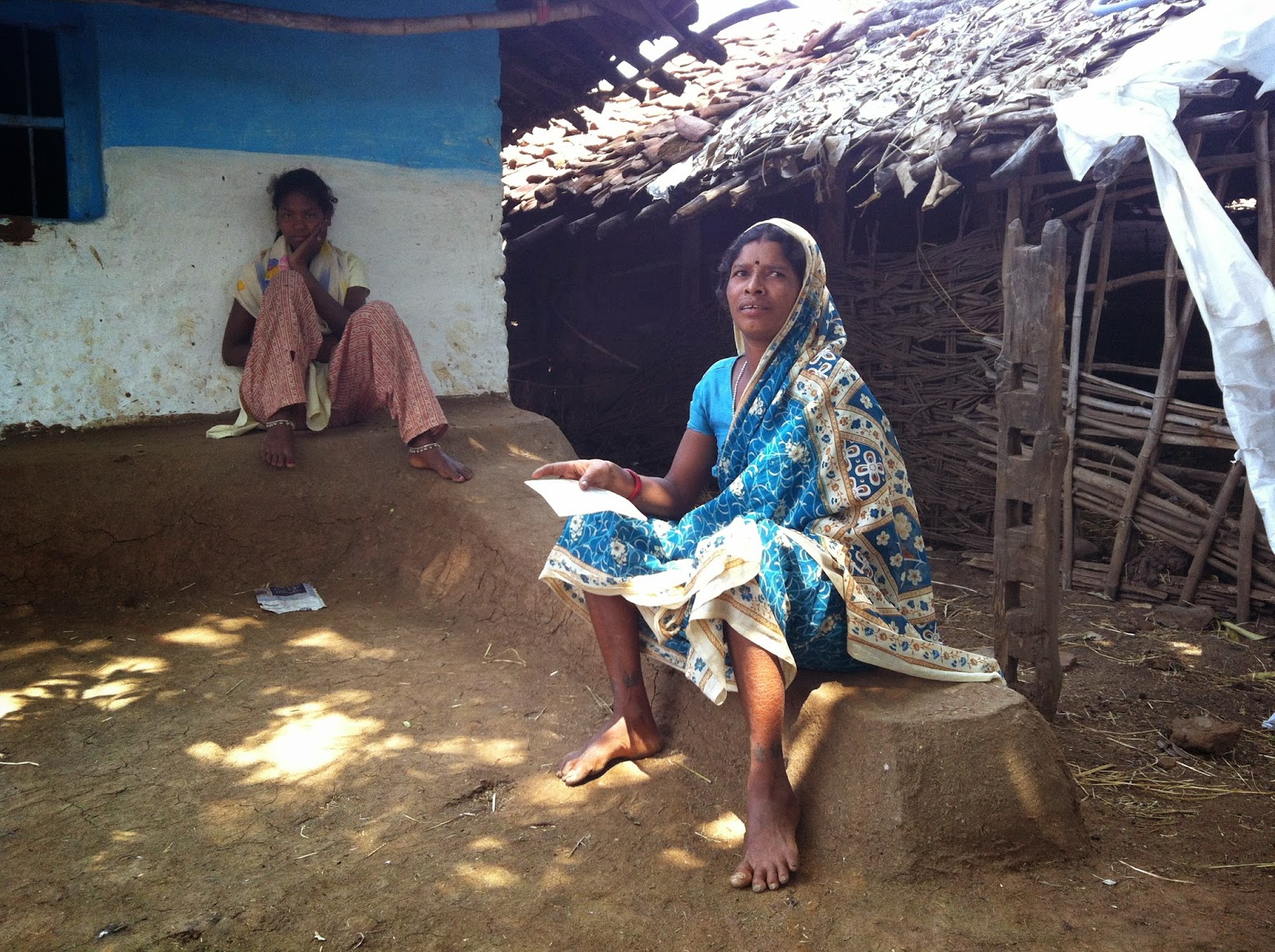
Women’s empowerment is usually measured by several macro level
indicators such as fertility rates, literacy rates, participation in the labor
force, and involvement in political affairs. While the importance of these is
undisputed, we believe there is also a lot of merit in understanding the issues
prevalent at the micro level. Micro level indicators help capture the dynamics
at play at the household level, which is critical for the understanding of
women’s empowerment. Understanding the micro issues is fundamental, as many
times, changes emanate from the small to the large. This micro approach helps
one understand why things
happen as contrasted with what happens,
which is what the macro approach reflects.
During our field visits to our study villages,
we have had the opportunity to experience certain micro level indicators. Just
by listening to conversations within a family, between neighbours, and among
friends, we have gained insights into the broader framework of issues prevalent
at the household level in villages.
For example, often when a survey is
administered to a female respondent, a sudden change is observed if any male
member of the household is present in the vicinity or happens to enter midway.
In some cases the female becomes more conscious or asks us to hurry up. In a
noticeable number of cases, the male member starts answering questions on behalf
of the female respondent while she has very little or no control over the
situation. It is only after our surveyors keep reminding the man that the
respondent is female that he begins to understand. These examples reflect the
reality of a women's position in a village where she is barely empowered to
take part in simple things herself, like the survey.
The rest of this article looks into five broad parameters which
can be used to measure women’s empowerment at the micro level. For each of
these parameters, suitable questions which can be asked are suggested.
Freedom - In order to elicit the
extent of
freedom that a woman enjoys, we could ask her if she needs to obtain
permission
from members in her household before traveling outside her house or not.
Further, supplementary questions could be asked, such as, the places
she is
allowed to travel alone, places she is allowed to travel with her
husband
etc. Another way to understand the freedom a woman holds in her
household is to
ask her if she can spend money from the household budget on herself
without
obtaining permission from her husband/father.
Another important aspect of
freedom, is the ability to make one’s own decisions concerning themselves. One way to assess the decision making power
of a woman is to ask her which decisions she can make entirely by herself, and which she cannot. For
example, one question could be to ask a woman whether she can go to high
school/college, work, and whether she can visit the doctor when she or her
children are feeling unwell. In such questions, since the responses come from a
pre-determined list of options, it is better to make it a categorical response
question instead of an open ended one, for the sake of ease of data collection
and analysis. For example, for a married woman, the responses could be she
herself, her husband, her father (if unmarried) jointly by her husband and her,
jointly by her father and her and lastly, some other member.
Perception - One of the biggest
obstacles to women empowerment is the opinion of women hold of
themselves. Many a times,
the cultural perception of women’s role in society is the very thing
that holds
them back. This is because when women themselves believe that they are
the inferior
gender, they automatically enforce behaviour that supplements a male
dominant
society. To understand how women perceive their roles vis a vis men, we
could
ask them questions such as: “Do you think it is fine for a man to hit a
woman
if she disobeys him?” or “Do you think your husband/father can make
better
decisions regarding the well being of family members compared to you?”
Another
way to understand a woman’s perception could be to ask her - “Did your
husband
hit you in the last week?” followed by a question on how it made her
feel.
However, the problem with such questions is that they could give a
biased
response as respondents are likely to answer what the surveyor wants to
hear
and are quite likely to hide such things. Therefore, questions which
simply ask
a woman of her opinion on physical abuse, verbal abuse, marital rape
etc. are
more likely to reflect her perception of her rights and responsibilities
as a
woman. For example, questions such as, “Do you have cases of physical
abuse prevalent in your village - where a man hits a woman if she
disobeys
him? How many such cases do you know? What is your opinion on this?”
Preferences - The issue of empowering
women comes into the forefront only when it is acknowledged that women’s
preferences
are different from that of men's. Also, because women are not empowered
enough,
more often than not, they are not able to fulfill their preferences. A
popular
study by Duflo et al titled, “Powerful Women: Does Exposure Reduce
Bias?” analyzed the village council’s decisions on fund allocation
towards local
infrastructure when one third of the village council leaders' were
women. Their study finds that this reservation of seats for women, for
the position of village council leaders, led to changes in policy
choices in ways that better reflected
women’s preferences. For example, when women were village council
leaders, they
invested more funds towards issues that were of higher priority to them.
While
this study acknowledged differences in preferences at a more macro
level,
within the household one could look at fertility decisions to
demonstrate this gap
in preferences. We could ask a woman what is the number of children she
would
have, if it was totally up to her, as against the number of children her
husband
preferred. Additionally, we could ask questions related to her and her
husband's
preferences regarding spacing within the household. These are innovative
ways of measuring the
disparity in the preferences of men and women. A higher gap highlights
the need
for empowering women and allowing them to take control of their own
decisions.
Awareness - The extent to which women know of
certain things, which are directly important to them and their children at the
village level, can be a good indicator of how empowered they are. In order to
understand this better, questions concerning women’s awareness can be asked on
critical subjects such as education, health and finance. Questions that inquire about
whether a woman is aware of the facilities available in the nearest primary
health care center, knows about contraceptive use and what medication to take
when she is unwell, can indicate her awareness levels on critical issues
concerning health. Similarly her knowledge on issues related to education such
as the broad courses available in college, availability of scholarships, and
the presence of any parent committees which may be present at the school level
can help a woman take a more active role on issues concerning education of her
and her child. Awareness about the presence of any microfinance organizations
in their village, having information about the different facilities offered by a bank and post
office are also good indicators of a women’s knowledge on important matters related
to finance.
This article has focused on women’s empowerment and the best
metrics to measure it at the micro level. While we must continue the efforts to
understand the dynamics of empowerment and promote such a cause, we must also
remember that this has to be accomplished in a challenging environment, where
there are a lot of forces seeking to disempower women (through exploitation),
rather than empower them. Thus, this makes the task of women’s empowerment all the
more complex, and all the more urgent in India.


