India Place Finder - A cutting edge GIS tool

http://www.developmentoutlook.org/2013/09/india-place-finder-cutting-edge-gis-tool.html
A cutting edge geographic information system tool to track
the Indian diaspora has been developed by Dr. Tsukasa Mizushima, a professor at Tokyo University. Dr. Mizushima and
his colleagues have developed the "India Place Finder", a
web-based application that allows researchers to find geographic information
about any place (known as toponym) in India. All places listed in the 2001
Census of India can be found via this tool.
Why is the tool
useful to researchers?
Researchers can query a place by either sorting through the
list, or narrowing the results by the State, District, or Sub-District. This
might sound a lot like Google maps - but it offers more. The tool provides
comprehensive topological context to a place, reaching back to 18th
century India until 2001.
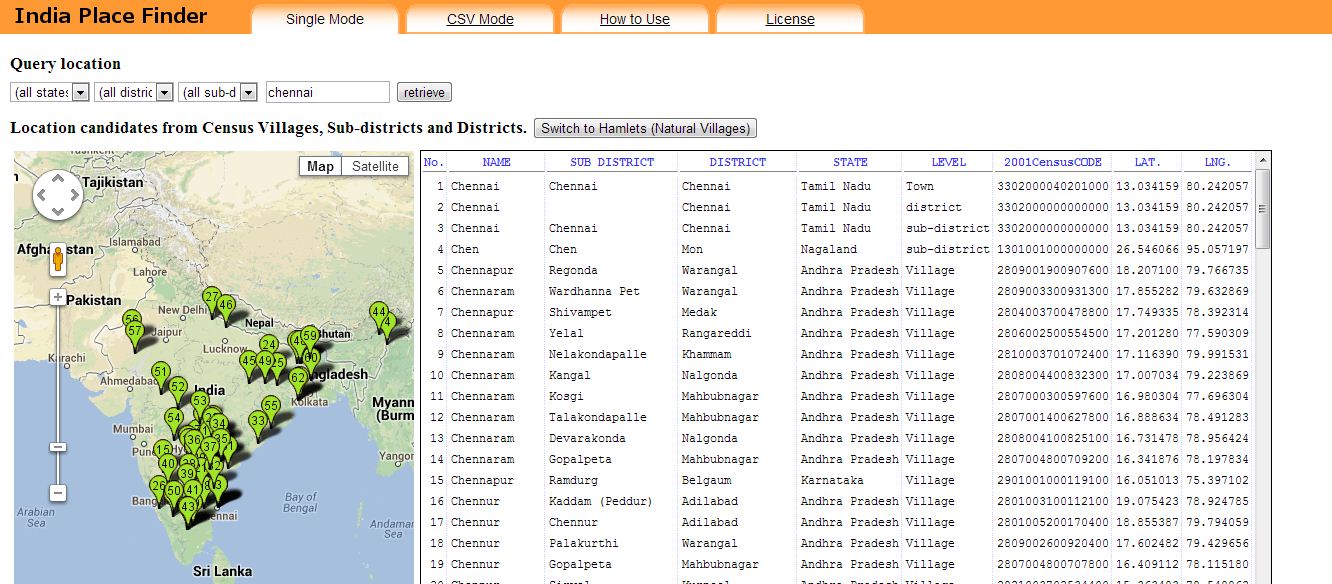
For example, if you search for “Chennai”, the tool shows all
matches for Chennai within India, both on a grid (with State, District,
Sub-District, Census Code, Latitude, and Longitude) and a map. In addition, all
notation fluctuations are also considered and therefore, other places similar
to Chennai appear in the results; in this case places like Chenai, Chen and so
on also appear on the grid and on the map. Upon zooming into any location, you
can find a detailed satellite or topological map.
 |
| Courtesy: India Place Finder (http://india.csis.u-tokyo.ac.jp/) |
So far, 900,000
villages have been included. Researchers can now track relatively obscure
places on the maps with exact coordinates, prior to conducting field work. The
tool is free to use, and easy to operate. The tool can be used to search one
place at a time (Single Mode), or multiple places at a time (CSV Mode).
Information from Census 2001 and 4,500 Survey of India topological
maps from 1869 onward have been used to create this vast database. The Government
of India restricts the usage of Survey of India maps and the digital framework around
Census information. Thus in order to make the map more comprehensive, Dr.
Mizushima worked with libraries and with open data sources to develop these maps.
For instance, Census 2001 district handbooks were used to map the villages that
appear on the tool.
_____________________________________
Dr. Mizushima is
currently a professor of South Asian History at the Graduate School of
Humanities and Sociology at Tokyo University, and specializes in the Indian
geographic and demographic history


Great find! This is a superb example of how a patient, long-term investment in understanding and transforming existing data can be revolutionary. The time and effort involved in creating this dataset is astounding, but the payoffs are huge. The India Place Finder is a gift to those of us conducting research in India. It would be great to hear more reporting on fresh Indian datasets with broad application to the research community. Far too often, great work isn't publicized. Thanks for the post.
ReplyDelete