
Understanding the Long Term Objectives of Microfinance - A Study on Client Graduation
http://www.developmentoutlook.org/2013/07/understanding-long-term-objectives-of.html
With recent developments in the banking Industry regarding
the Reserve Bank of India’s call for applications for bank licenses, underlining
financial inclusion as a criteria for assessment, the question rises as to
whether MFIs (Microfinance Institutions) are likely to be good banks. So far,
two MFIs have applied for bank licenses and Abhay
Agarwal’s previous post conducted a SWOT analysis of both as well as
another major candidate, the Indian Postal Service.
The question I’m interested in however, concerns a very
niche part of the market. Namely, if MFIs become banks, what are the
implications for mature client graduation to formal banking?
In its formative years, two schools of thought on
microfinance prevailed. The first believed that long term clients would fulfill
their working capital needs and would no longer need loans in the long term, a
rather naïve idea given that every business needs to borrow in order to finance
its working capital needs and expand. The second school of thought believed
that the clients who are able to repay loans would eventually graduate out of
poverty and no longer need MF loans and would possibly move on to borrowing
from banks. This has not been the case as observed so far.
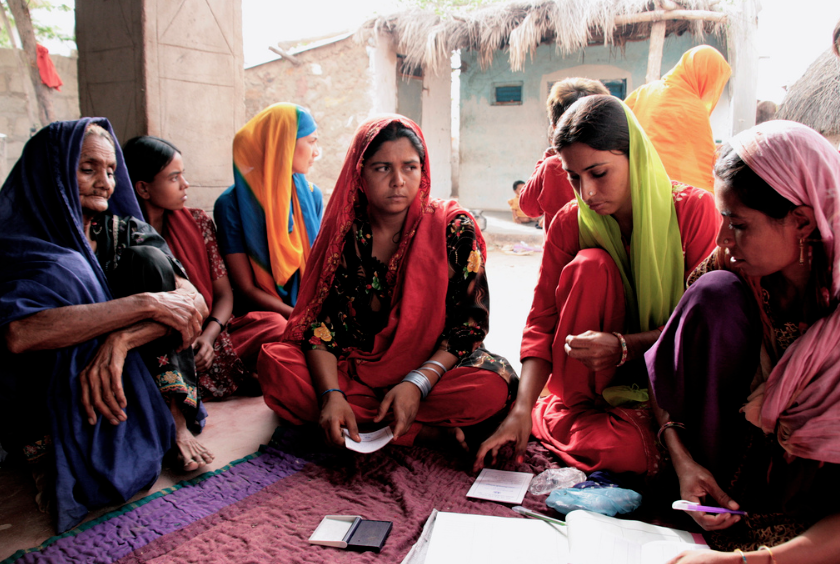 |
| A Group Meeting in Gujarat |
There is a significant lack of literature on the graduation
of long term microfinance clients to formal banking, the reason being that very
few do. The reasons for client exit however, have been studied
in depth.
To discuss client exit, we must start with classifying loan
holders by the type of loans they take - productive/working capital loans
versus consumption loans. With respect to consumption loan clients, due to the
nature of their monetary requirements being unsustainable as well as
(typically) need focused, the loan cycles for these clients tend to peak at
three (meaning they are able to engage in three consecutive loan cycles with
their respective MFI). Typically, they tend to drop out of the MFI by the
fourth loan cycle. Either they are unable to repay their future loans or, once
their respective consumption requirement is fulfilled, they simply don’t
require more loans. Working capital loan clients however, tend to engage in a
larger number of loan cycles, assuming they are able to profitably manage their
businesses. These clients also tend to be richer due to the profitability of
their businesses and are the specific sub-group we refer to when we talk about
graduation to formal banking. One may ask why we would be particularly
concerned with this sub-group since they appear to clearly have the resources
to graduate to banking and tend to benefit the most from microfinance, as recent
impact evaluations suggest.
The reason is, conventional school of thought assumes that
the financial sustainability of MFIs is dependent on these clients since they
have successful credit histories and can take larger loans, which is more
profitable for the MFIs as their cost of loan delivery is the same regardless
of loan size. As such, there lies a conflict of interest between MFIs
encouraging these clients to graduate to formal banking and retaining these
clients to maintain financial sustainability.
I emphasize ‘conventional school of thought’ because there
is a lack of analysis of what proportion of a typical MFIs portfolio consists
of fourth to fifth cycle clients versus first to third cycle clients, in the
current Indian microfinance climate.
As such, we are left with a few substantial questions:
- In practice, what percentage of the average MFI’s lending portfolio comes from larger working capital loans to long-term clients?
- What resources do MFIs offer to long-term clients to graduate to formal banking? In turn, what resources do banks offer these clients to help them graduate?
- Most importantly, do these long-term clients express a demand for larger loans from formal institutions? And if they do, what are the factors hindering them from taking up these loans?
- What is the size of this client market, which wants to graduate?
These are questions we will try to address in CMF’s upcoming
project, Vertical Mobility in Access to Finance. We plan to survey clients, MFI
leaders and banks in order to conduct a qualitative and quantitative study of
this client market.
If the answer to the first question is insignificant, then
it is imperative that MFIs be encouraged to help their clients graduate since a
significant market gap has been previously identified for clients looking for
larger loans for productive purposes. The data from question four could help us
determine the size of this untapped and possibly profitable market comprising
of long term microfinance clients with successful credit histories looking for
loans larger than the amount MFIs are legally allowed to disburse.
However, if the answer is significant, and a demand for larger
loans by these clients is observed, it implies that microfinance institutions
could technically be discouraging their long-term clients from graduating
formal banking institutions! What are the implications of this interpretation?
It implies that microfinance may be imposing a credit constraint on this client
niche instead of relaxing it, thus directly contradicting its social
objectives.
With respect to MFIs becoming banks and the implications for
client graduation; depending on regulation covering MFI-banks and the
respective limitations on high-risk portfolios comprising of collateral-free
loans, this client niche actually stands to gain significantly. Regardless of
whether MFIs currently depend on this client group for financial sustainability
or not, their long term clients could access larger loans, especially if they
were allowed to easily switch between the microfinance and banking wings of
these institutions with relaxed collateral requirements.


