The Need for Ruralization

http://www.developmentoutlook.org/2013/07/the-need-for-ruralization.html
"India lives in its villages."
Mahatma Gandhi
After nearly sixty years, Gandhiji’s statement still holds
true. From the social, economic, and
even the political perspective, India is still very much rural.
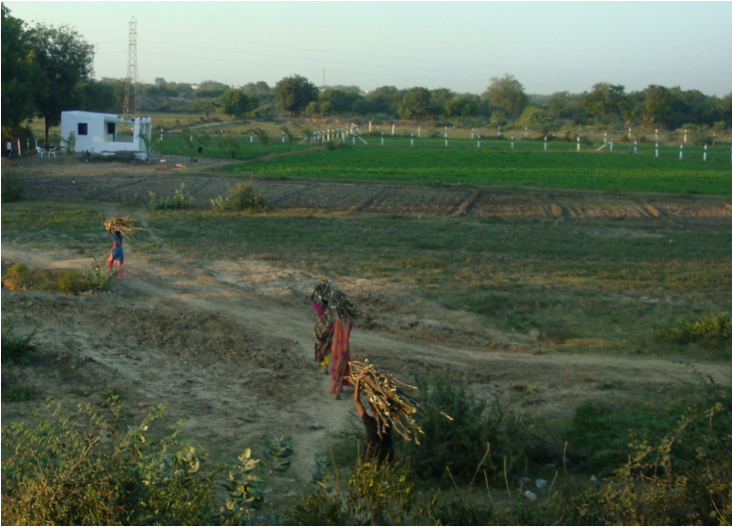 |
| Gujarati women working as Agricultural Laborers |
During the 2012 monsoon season, Gujarat endured one of the
worst droughts in recent years. Living
in Ahmedabad, I felt largely unaffected.
I read the news about farmer suicides in Saurasthra (western Gujarat),
drove past the dried out Sabarmati River, and heard the phone calls from our AO
study farmers asking our agronomist about coping mechanisms and when the rains
would arrive. But my life continued - as
did the lives of most urban Indians. I
realized that even though I live in a developing nation, I’m protected from
certain shocks since I live in an urban center.
Unsurprisingly, the rural inhabitants are acknowledging this too and migrating -
either seasonally or permanently - to the urban areas in search of this
protection. They’re searching for the
same things I am: employment opportunities, better infrastructure, education,
and access to markets. But as students
of development economics, we know the problems of urban migration and the laws
of supply and demand.
Before working on AO, rural India was a mystery to me. My perception came solely through books/textbooks,
media, and films. On one hand, I found
myself glorifying rural India (thanks to Bollywood); on the other, I wondered
how someone could truly be “happy” living a “poor” rural life - especially if
they had the option to move to a city and find work. I assumed that most in rural India dreamed to
migrate to the cities. I made many assumptions.
During my stay in Gujarat, I grappled with this question: Is it
better to live a rural life and face these potential shocks or is it better to
migrate to an urban center and face the hardships of urban life and even urban poverty? I understand that there is no correct answer
to this question and it depends largely on the particular circumstance of an
individual. As we are taught in
economics 101, individuals are rational thinkers and make decisions that
ultimately benefit them; however, the problem arises when there is asymmetric
information, which is often the case.
After working on the AO project, I’ve learned and come to
appreciate rural India. I’ve found that rural India is rich in culture and extremely welcoming. I’ve also learned that “rural” doesn’t necessarily
equate to “poor”. Rural people are not a
bunch of unhappy people struggling and trying to migrate to the urban areas. They have deep-rooted histories and connections
with the land they live on. They live in
communities, have support systems, and can trace their ancestry back to
generations. I barely know my neighbor's name, let alone my great grandparents’ names.
The rural lead dignified and often simpler lives.
During some of my field visits to Surendranager to visit our
study farmers, I was amazed to see so many televisions. Many of our farmers are uneducated and/or
illiterate (the average years of education in our sample is 4 years and 40% are
illiterate); however, everyone in our sample has a cell phone (they had to for
our study) and most seem to have a decent income through agriculture (an
average of Rs. 10,200 per month). While
many of these farmers are not financially poor, they appear to spend money in
what I, coming from an urban area in a developed country, would think is
irrational. Instead of investing in
education and food, I saw people investing in entertainment - but perhaps this
is what the households value more?
Perhaps it’s simply a question of taste and preferences or maybe it is a
lack of education? With televisions and access
to media and entertainment, the rural population is also becoming aware about
the trends in the cities and is aspiring to lead a certain life - they often
glorify the city life.


Ishaniben,you simply don't think like a Gujarati, who are the largest Indian migrant community in the US ( and please no offence). Gandhiji also said that "Be the change you want to see in the world." And though I know these views are yours not of the org you represent the same org refused to give 54 rupees to somebody who was staying in one of these semi-rural locations and trying to work with very basic infrastructure. I hope this outlook of yours will rub on your on colleagues. And to say the rural people don't invest enough in education is not correct. They simple don't have enough surplus to educate in quality education. the quality of education in these village based institutions is so low so it doesn't offer much value. Check somebody who has a BA/MA from a village based education and how good he/ she is for the job market(your field surveyors for e.g) and what can be realistically earned by that education.
ReplyDeleteDear Sir,
DeleteI think you missed Ishaniben's point here, which is primarily to call out to India to focus on ruralization, which INCLUDES improvement in education, infrastructure, income (thus educational investments) and so on. Yes, education quality is abysmal, and often parents do not have the funds necessary to meet the education expenses, but this is what calls for ruralization.
Furthermore, I do not know much about this organization, but from the website it appears that their work focuses on development research and institutional level change through policy. Your 54 rupee comment is petty and has not place here.
Sincerely,
My tone may have been sarcastic but I did not miss anything here. "I saw people investing in entertainment - but perhaps this is what the households value more? Perhaps it’s simply a question of taste and preferences or maybe it is a lack of education? " - my response was based on that observation. As far as improvement in rural infrastructure is concerned , the govt. has been doing it but how efficiently, is a matter of debate. Our population has multiplied since Independence so it has put a constraint on our resources. Migration is a personal choice, and if I am not wrong the author herself was born in a family which migrated to the US. Was it good decision , poor decision , its for them to decide but they gave her more and probably better opportunities than they had. I know this organization and my comment maybe petty in your opinion but its true ? Aren't researchers meant to get to the truth ? And I deliberately gave a small example, things were much worse. And the same organization has started to block critiques. Thats all
Delete