Understanding Chhattisgarh’s livelihood landscapes through PRADAN’s initiative

http://www.developmentoutlook.org/2012/11/understanding-chhattisgarhs-livelihood.html
In a series to understand the ground realities of livelihood opportunities
for the poor, CMF is currently interviewing a set of recognized practitioners.
In our first episode, we feature Saroj Mahapatra, Programme Director, PRADAN - Chhattisgarh.
PRADAN is a non-government, non-profit organization which works across seven of
the poorest states in India with more than 2.68 lakh rural families to improve
lives of the rural poor, by instigating systems that expand sustainable
livelihood opportunities.
Chhattisgarh is one of the poorest Indian states according
to the measures defined by the Human Development Index (HDI). PRADAN aims to organize women from rural families into Self Help Groups to enhance their sense of
agency and livelihood capabilities for developing secured livelihood
opportunities.
Agro-climatically, the entire state of Chhattisgarh falls in the category
of Zone VII (Eastern plateau and hills zone) and can be subdivided into three
sub agro-climatic zones. North and South Chhattisgarh have similar
characteristics in terms of natural endowments and demographic profiles.
Central Chhattisgarh is characterized by the presence of industries and more urbanization from rest of the state. The tribal communities of Chhattisgarh
inhabit the densely forested, mineral-rich districts of North and South. Chhattisgarh’s southern region has been in the
limelight because of the on-going Maoist insurgency, including a recent 13
day capture of the district collector.
Mr.Mahapatra says, “The southern region houses the Bastar Plateau, one
of the most problematic and deprived zones. It is heavily forested, with almost
50% of the belt covered by forests”.
 |
| Image Credit: PRADAN website (www.pradan.net) |
Further, Mr. Mahapatra explains, “Here in Chhattisgarh, more
than 80% population depends on agriculture. Main crops are paddy, maize, pulses
and oil seeds Over 70% of the total workers excluding marginal workers are
engaged in cultivation or as agricultural laborers However agriculture is
rain-fed as only 21% of the net sown area is irrigated. Though 67% of the total
cropped area is rice, the productivity of rice per hectare is very less.
Agriculture is the major source of income for the rural households in
Chhattisgarh and income from agriculture is supplemented by income from wage labor, forest produce and livestock.”
Major developmental challenges of the area are lack of food
security from cultivation, low production levels leading to less investment in
husbandry of resources, limited irrigation infrastructure, limited
participation of women in mainstream agriculture, underdeveloped markets and
services related to agriculture, limited accessibility to government schemes,
and over-dependency on eroding Non Timber Forest Produce (NTFP). PRADAN’s
experience of working in various poverty pockets of Chhattisgarh indicates that
positive changes in the immediate micro environment through appropriate
processes and technologies can bring about the desired changes in the quality
of life of people and overall economic impact in the local area. According to
Mr. Mahapatra, “PRADAN teams are following the comprehensive intervention
approach for sustainable impact of livelihoods at the family level through
community mobilization for mutual support among members, solidarity, and leveraging
resources from government - creating assets, bringing resources under
integrated farming system and utilizing them in an optimal but sustainable
manner, increasing the productivity and total production of existing crops, and
adopting new technology on farm and forest based livelihoods.”
One of PRADAN’s major drives in the last couple of years has
been the introduction and promotion of an innovative rice production technique
called System of Rice Intensification (SRI) with small and marginal farmers. This
methodology aims to increase the productivity
of rice by early transplantation of seedlings, transplanting one seedling per
heel at wide spacing, and ensuring weeding and hoeing. “PRADAN has partnered
with 11 other NGOs from the state to advocate this system across 16,500 farmers
in 404 villages in 11 districts. The state government of Chhattisgarh has now
shown interest in the drive and is willing to get this strategy across to
50,000 farmers. Currently, the production capacity of paddy in Chhattisgarh is
low at about 2 metric ton per hectare, however, the potential to increase
productivity to 5.5-6 metric ton per hectare exists”, says Mr.Mahapatra.
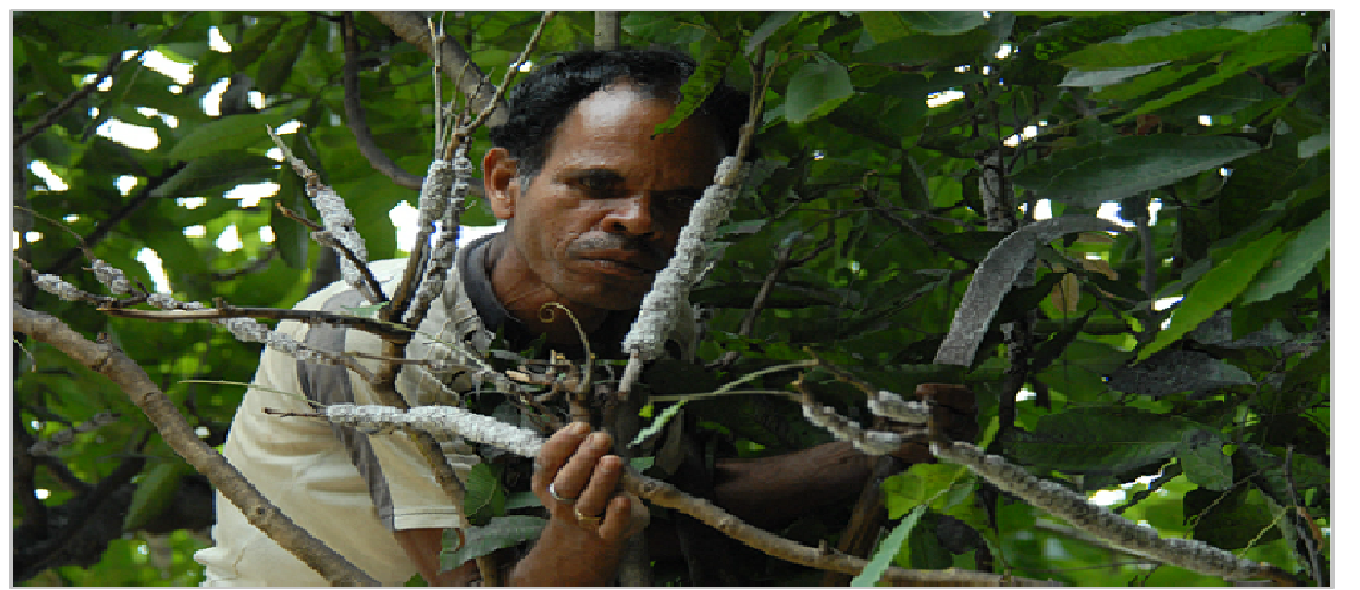
Pradan also works to enhance and improve forest based livelihood
opportunities by backing scientific cultivation of lac and tasar, host plants that
are available in the forest fringe areas in Chhattisgarh. When asked whether
forest based livelihood interventions are affected by the protectionist
policies of the local authorities, Mr.Mahapatra was quick to highlight that
such programs are carried out in conjunction with government agencies such as
the Department of Forest, Government of Chhattisgarh.
Highlighting the gaps in implementing livelihood programs for the poor and
how research could help fill some of the holes, Mr. Mahapatra expressed the
requirement of needs assessment studies. He said it was imperative to
understand the micro-economic household behavior especially in the tribal
regions. Such studies will help practitioners and service providers such as
Pradan identify what strategies are needed to navigate certain conflict prone
zones. Pradan is seeking to understand the emerging livelihood sectors in the
state, in order to replicate interventions that have worked well. It is also
important to understand the geographical context of the state as the north and
the south are environmentally different from the more developed central
regions. As Chhattisgarh is primarily a mono-crop region, he directed
researchers to look at innovative paddy production techniques.
Samik Adhikari and
Deepti K.C.
Center for
Microfinance at IFMR Research
The authors would like to thank Mr. Saroj Mahapatra from
PRADAN for answering a list of questions on livelihood activities in
Chhattisgarh and for making necessary edits to this article.


