Analyzing the BC Model (Part II) Why isn’t it working? - Dormancy of No-Frills Accounts

http://www.developmentoutlook.org/2012/10/analyzing-business-correspondent-model.html
[Terminology Used: Agents or Customer Service Points (CSPs) -
Individuals, shops or other outlet points responsible for direct contact with
clients. They open bank accounts, check Know Your Customer (KYC) requirements,
carry out money transfers and transactions and in some cases, extend credit by
linking the client to the base branch]
In our previous
post, we discussed the general advantages of banks using Information
and Communication Technology based business correspondents to fulfil the
financial inclusion goals of the RBI. Yet, the model hasn’t been performing up
to expectations so far and major concerns have been raised with respect to its
financial sustainability for CSPs. Some major issues that have come up so far
include:
(i) Dormancy in
No-Frills accounts
(ii) An asymmetry between
agent/client needs, and operational procedures of BCs and Banks
(iii) Issues over the financial
viability of the model itself.
In this post, we’ll discuss the reasons for low usage patterns of
No-Frills accounts.
Dormancy of No-Frills Accounts (NFAs)
Around 20% or less of the 100 million NFAs opened so far have been deemed
as active. According to the agents in the sample for an upcoming CMF study,
around 41% of the clients with NFAs transacted ‘at least’ once in 3 months,
with the remainder transacting more infrequently or not at all.
A primary reason for this dormancy could be the supply driven approach
of account opening drives where banks have focused on simply fulfilling their
financial inclusion requirements.
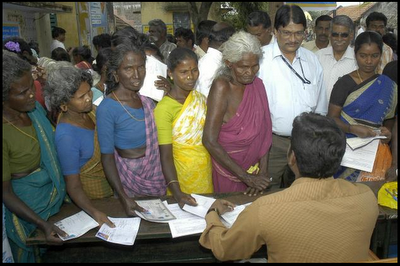 |
||
A No-Frills Account Drive (Source: Business Line)
|
In the sample for CMF’s study, 70% of NFAs opened belonged to
people who already had a primary bank account. This opposes the entire purpose
of these financial inclusion drives. However, with respect to account usage,
the same research study found that people who have both a standard bank account
and an NFA tend to use their NFA more often due to its convenience.
Then what seems to be the problem? Reported operational issues include a
processing time of 2-3 months for new accounts, by which time the users lose
interest and the accounts become inactive while the focus on simply fulfilling
RBI’s financial inclusion requirements has resulted in banks overlooking the
need for imparting financial education to clients.
Banks have also done very little to actively promote the use of the NFAs
by customers and BCs which initially focused on marketing have stopped doing so
due to high promotion costs which are not financially viable. A study conducted
by Microsave demonstrated that most financially excluded
target customers opened NFAs simply to receive wages under the National Rural
Employment Guarantee Act (NREGA). These accounts exhibit more transaction
activity and increase the banks cash reserves. Yet, in the absence of financial
education, account holders simply withdraw the entire amount as soon as they
receive these payments.
Research on NFA costs estimate that banks tend to lose money on these
accounts due to low transaction activity and balances, which could explain
their reluctance in investing in awareness campaigns. However, this could
result in a negative feedback-loop as the continuing unawareness of clients
with respect to the uses of NFAs could simply reinforce these losses.
A CMF survey found that not only were most NFA clients unaware of the
uses of NFAs, they were unaware of the limits on transaction volumes as well.
There are reports of cases where, due to lack of awareness about the account
and its usability, clients are unable to provide account details to access
their insurance reimbursement.
Clients have also expressed dissatisfaction at the fact that some banks
do not provide ATM cards or cheque books along with the accounts, restricting
the use of their NFAs to just BC outlets. They also desire a regular account as
the tag of ‘No-Frills’ has become synonymous with poverty. In an effort to fix
some of these issues, the RBI issued a request to banks this month to drop the
'no-frills' tag and rename these zero balance accounts as ‘basic savings’
accounts and provide ATM-cum-debit cards without any extra charge.
In the next
post in this series, we will talk about the second reason for
the disappointing performance of the BC model - a mismatch between agent/client
needs and bank regulations.


No- frill accounts are really convenient for people ,but only after people are literate enough about their actual purpose. RBI's suggestion is really appreciable to enhance scenario of no-frill accounts.
ReplyDeleteIt’s a classic great for me to go to this blog site, it offers helpful suggestionsNorth Parramatta
ReplyDelete