
Newsletter Article - Digital Data Collection - Experiences from Uttar Pradesh
http://www.developmentoutlook.org/2012/07/newsletter-article-digital-data.html
Authors
- Sitaram Mukherjee, Mudita Tiwari
In partnership with FINO, CMF is evaluating a door-to-door step banking services, FINO has a
network of Business Correspondents or Bandhus, who open no-frills savings
accounts with the Union Bank for the clients. They operate in areas where formal banking
services are not available and clients belong to low-income groups.
The
Bandhus use terminal (hand-held) machines to conduct savings and withdrawal
transactions. The baseline data collection was conducted in Varanasi and
Azamgarh districts of Uttar Pradesh to assess the household information, income
and expenditure habits, loans and savings information. The clients were also
provided basic Financial Literacy Education by FINO. With the endline currently
underway, the most innovative part about the endline process is the digital
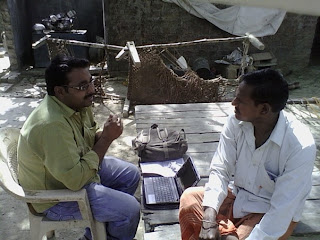
data collection being conducted on the notebook and the tablets. Currently 12 notebooks, and 12 tablets are
being used to survey a sample size of 3,000.
This
is the first CMF project where digital data collection has been used extensively
to conduct a survey, and there have been interesting challenges. We wanted to highlight some key lessons:
Training: A dedicated team should be
hired with prior field experience and basic computer knowledge. It is advisable
to use local flyers and newspapers for recruitment purposes. Each surveyor went
through specific training in using the tablet and the notebook. The surveyors had the choice to select the
device they wanted to work on and their skillset matched the device they were
working on. Two weeks of extensive training included use of devices,
questionnaires and even mock calls.
Basic infrastructure: Setting up an infrastructure to
support electronic devices is important. Backup generators were required in
Varanasi so that the devices could be charged as there is limited supply of
electricity. Voltage fluctuations could also lead to device damage. Hence
safety of such devices is of utmost priority. Monitoring of devices need to take
place daily and issues pertaining to them should be addressed without delay.
Data security is also vital, data from the notebooks had to be downloaded daily
and backups were maintained regularly.
Robust Software: Software designing for the data
entry devices should commence as early as possible; at least one month should
be spent in developing the software, and another one month in testing the
software. Following must be kept in mind
for the software:
a. Questionnaire
timeline and piloting
- Ideally the questionnaire should be finalized before the software is
developed. The questionnaire should therefore be piloted rigorously to ensure
the questions are pertinent, clear and concise, logical patterns are followed
and the appropriate skips are in place.
b. Questionnaire
size and complexity
- The software should be able to handle the size and the complexity of the
questionnaire. In case the surveys makes use of lots of grids (such as
household rosters),
c. Interface - Interface should be user-friendly. The developers may use tooltips and help
buttons to provide instructions.
d. Software
stability
- The software should be stable and data loss should not occur in case the
device stops working. An auto-save feature should be in place. If the devices
are unusable for any reason, backup devices should be available, and should be
easily configurable.
Piloting: The devices should be used to
conduct pilots in the field only after the questionnaire has been piloted
separately. Classroom training has been provided to the field staff on the
devices and the questionnaire. This is to assess how familiar the field staff
is with the devices and solidify their data entry skills. The piloting can be
conducted until the data quality is acceptable. Changes to the software if any
should be done for every device and the software team should ensure that the
database structure and the software version are consistent across all devices.
Data Validation and Accuracy: Once the data collection
starts, it is essential that the supervisors and monitors be involved in
accuracy checks of the responses. The
issues are:
Back-checks - Supervisors and monitors should
conduct a 100% back-check and ensure that the logical patterns are followed and
the skips are appropriate. The supervisors
and monitors must go to the client’s house to compare the responses. If error rate is below 50%, then the errors
are resolved in the field and the new answers are recorded. Else, the entire survey is conducted again.
The error rates are recorded for each surveyor so that surveyors can be
retrained if required. Surveyors are never told in advance which questions will
be back-checked to ensure quality checks are random.
Machine Issues - There are incidents when the
machines freeze, shut down or discharge in the middle of a survey. Therefore,
it is critical that the data be saved regularly preferably after each question
or section so that the entire data is not lost.
Paper surveys may be given to the surveyors in case the machine shuts
down as backup methods to continue on with the survey. These answers can then
be entered when the device is operational.
Data Backup - Each night the data from all
devices is merged and automatically sent to a central server for back-up (for
tablets only), or is manually uploaded to a backup server (for the notebooks
only). The data can then be downloaded
and analysed for accuracy.


Each surveyor went through specific training in using the tablet and the notebook. The surveyors had the choice to select the device they wanted to work on and their skill set matched the device they were working on.
ReplyDeletevirtual data rooms