Child Care: Whose Responsibility is it?

http://www.developmentoutlook.org/2016/01/child-care-whose-responsibility-is-it.html
How many of us had our fathers waking us up to get
us ready for school, cooking meals for us, attending parent teacher meetings,
and being home when we returned from school? - I didn’t. And the majority of
the people around me did not. In most parts of the world, childcare
responsibility primarily falls on the women, and this is especially true in the
case of India.
Indian
scenario
In the recent times, much has been said about women
sharing the larger burden of household and childcare responsibilities. From
Indra Nooyi (CEO of PepsiCo), who said “Women can’t have it all” to Sheryl
Sandberg’s (COO of Facebook) book Lean In - they all talk about the undue share
of these responsibilities that women have to take and how it adversely impacts
their participation in the labor market.
In India, female labor force participation has been
on a decline even though there has been an overall rise in economic growth. According
to the ILO’s Global Employment Trends 2013 report, between 2004-05 and 2009-10,
female labor force participation rate has fallen from 37 to 29 per cent. Socio-cultural
factors like the patriarchal nature of Indian society, discriminatory practices
against women at workplace etc. have been and are still, contributing to this
trend. However, there are other factors which can be attributed particularly to
this trend of declining female labor force participation. One of these is
household income. As household incomes are increasing, the pressure on women to
work is less, and it also becomes a prestige issue. In order to maintain the
family status, women stay at home (Bhalla & Kaur, 2011; Mahapatro, 2013). Childcare
is one of the factors which has played and still plays a major role in this
trend but has not received much limelight in the policy space.
Childcare
responsibilities in urban settings
If we consider childcare as one of the primary
hindrances to women’s participation in the labor force, then what are the possible
ways to overcome this challenge? One could think of some possible solutions
based on experiences of other countries as well as the recent trends in India.
For instance, countries like Sweden and Norway offer more than a year of paid
maternity/paternity leave for each child. Many companies offer the option of
work-from-home and flexible work timings. Recently, in India, Flipkart
introduced a range of policies to support new parents in their childcare
responsibilities. These included six months of paid maternity leave, transport
reimbursements for the two months prior to the maternity break, and sharing of
day care costs till the child is four years old. One could also enroll their
child in one of the numerous private crèches or day care centers that have come
up. There is also an option of hiring a full-time nanny.
Although, all these are positive developments that
would enable women to be part of the labor force, they seem to be geared
towards women employed in skilled jobs. What happens when a women is working on
a road construction site? Can she work from home? Can she have flexible work
timings? What happens when a women gets her earnings on a daily basis? Can she
get six months of paid maternity leave? The answer to all these is a “No”.
Also, these women cannot afford to pay for private day care services or a
nanny.
Childcare
responsibilities in low income households
So, the question remains - What can low income
households do to manage their childcare responsibilities? One thing that comes
to mind is the government’s ICDS program. One of the services under the ICDS
scheme is pre-school and non-formal education for children in the 3-6 years age
group, provided through anganwadis. Although this is a great intervention by
the government and includes a number of other services for children in the 0-6
year age group and mothers, the ground reality is far from promising. As my
experience in Udaipur goes, the anganwadis are located at the village level,
and are usually close to a major road or highway. This makes it difficult for households
in the interior and remote hamlets to access it. Also, in a majority of the
villages the services in the anganwadi seem to be limited to distributing food,
and at few locations it runs as a pre-school for about 3-4 hours per day. This is not sufficient for parents who work
atleast 8 hours a day.
Given these problems with the anganwadis and the
absence of any other formal child care arrangement, low income households
resort to a number of methods like leaving their young children alone at home,
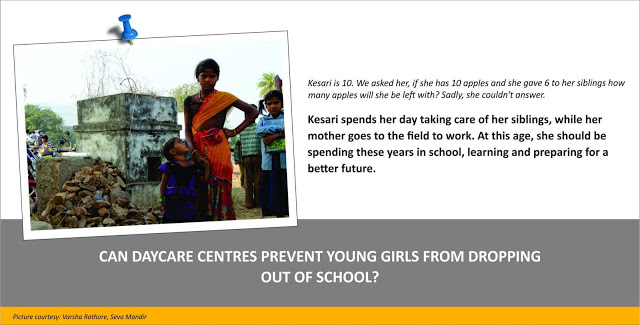
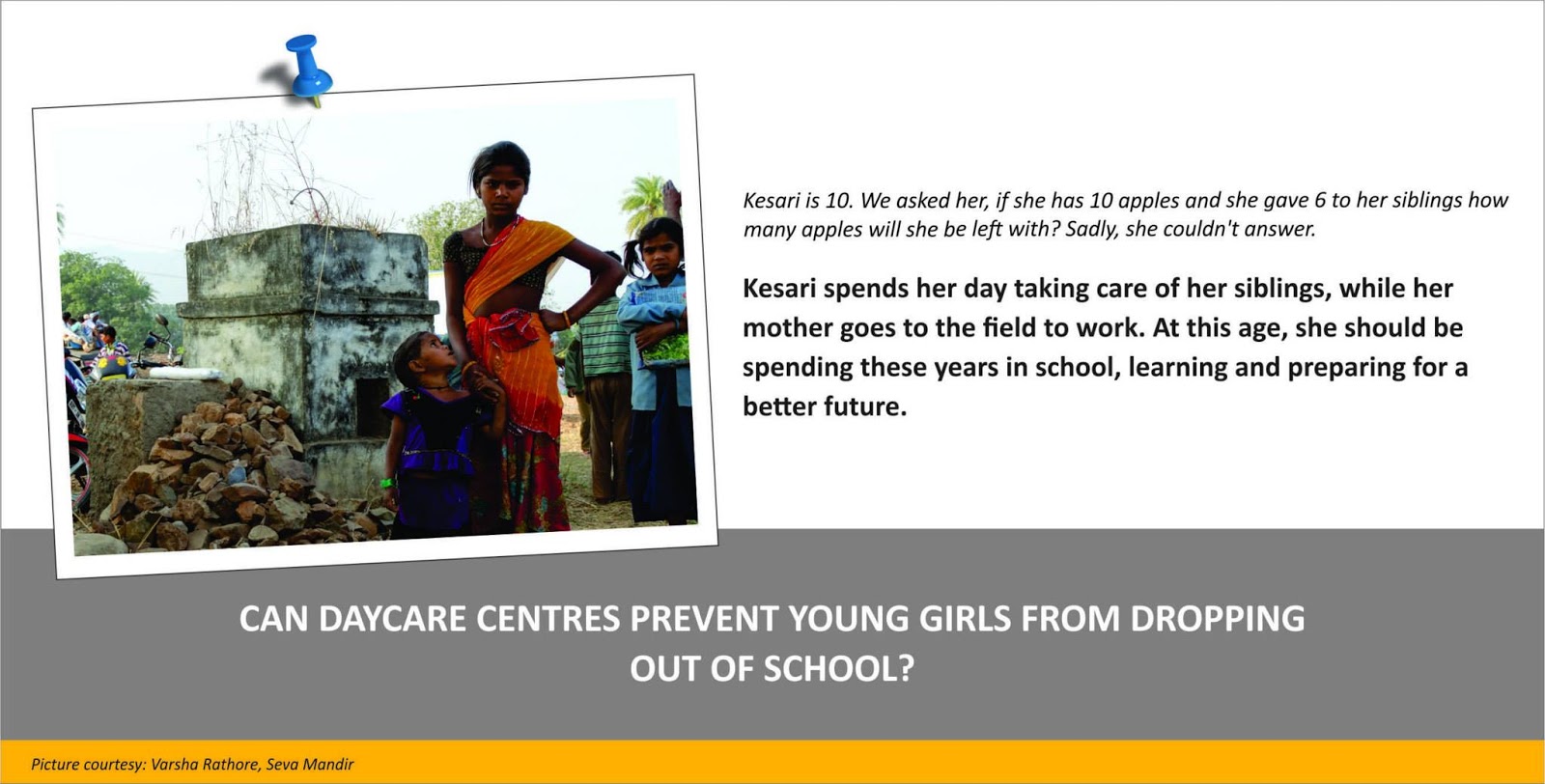
making elder children stay at home to take care of the small children, taking
the children with them to work where they will be unsupervised or not work at all.
Given that low income households are more in need of financial resources, they
have no option but to resort to these measures. However, these measures are not
safe for the children, adversely impact the elder siblings, and restrict women
from being employed. Due to a gross lack of evidence on this topic, especially
in India, we need to start thinking of ways in which we can encourage women’s
participation in the labor force, and at the same time provide a safe
environment for their children, who belong to low income households.
Evidence
from other parts of the world
Studies
in other parts of the world show that child care provisions have a positive
impact on the women, children as well as the household. A study in the low
income neighborhoods of Rio de Janeiro, Brazil found that the provision of free
day care services increased mother’s employment from 36 to 46 per cent and
almost doubles the employment of mothers who were not working before (Paes de
Barros, Olinto, Lunde, & Cavalho,
2011). Another study in Guatemala evaluated a government sponsored day care
service program for poor families. This program required mothers to be working
outside the home, and was run by a woman from the community. The program also
had a significant impact on the labor market outcomes for women. It enabled
mothers of these children to be engaged in employment in the formal sector, and
their earnings were also higher, as compared to women who used any other child
care arrangements (Ruel & Quisumbing, 2006). A study in Argentina, which
assessed the impact of the provision of free pre-primary school facilities
found that that if there is full take up of the program, the maternal labor
force participation rates would increase in the range of 7 to 14 percentage
points (Berlinski & Galiani, 2005).
Generating
evidence in India
Given the scarce evidence on the type of childcare
arrangement that works best in different settings within India, and how the
same impacts mothers and their children, there is a need to engage in rigorous
evaluations of these different childcare arrangements. With this objective, IFMR
LEAD in collaboration with McGill University, IDRC, and Seva Mandir have been
engaging in a study to evaluate the impact of affordable community day care
centers on women’s labor force participation, women’s social and economic
well-being as well as the health of children, in India. As part of this study,
we are evaluating a community day care model called balwadis, run by a local
NGO, Seva Mandir in the villages of Udaipur district. Through this project, we
aim to generate evidence on the impact of day care centres on women’s
participation in the labor market and the well-being of their children. We hope
the findings from this study could be used effectively to influence government
programs and policy decisions on child care.
To know more-
Project Page: Affordable Day Care to empower Indian Women
Stories from the field: How Parents in Rural India are dealing with Childcare?
To know more-
Project Page: Affordable Day Care to empower Indian Women
Stories from the field: How Parents in Rural India are dealing with Childcare?
---------------------------------
References
Anderson, E. M. (2013). Women and
Children First? Labor Market Effects of Universal Child Care for Toddlers. University of Oslo, Department of Economics
Bhalla, S. S., & Kaur, R. (2011).
Labor Force Participation of Women in India: Some facts, some queries. Asia Research Center, Working Paper 40.
Berlinski, S., & Galiani, S. (2005).
The Effect of a Large Expansion of Pre-primary School Facilities on Preschool
Attendance and Maternal Employment. The
Institute for Fiscal Studies, WP04 (30)
International Labour Organization.
(2013). Global Employment Trends.
Mahapatro, R. S. (2013). Declining
Trends in Female Labor Force Participation in India: Evidence from NSSO. Munich Personal RePEc Archive, Paper No.
44373
Paes de Barros, R., Olinto, P., Lunde,
T., & Cavalho, M. (2011). The Impact of Access to Free Childcare on Women’s
Labor Market Outcomes: Evidence from a Randomized Trial in Low-income
Neighborhoods of Rio de Janerio. World
Bank Economists’ Forum.
Ruel, T. M., Quisumbing, R. A., Hallman,
K., Briere, B., Salazar, C. N. (2006). International Food Policy Research Institute, Research Report 144