
For many of
India’s 850 million rural inhabitants, 40 per cent of whom live in poverty,
delivering agricultural output in a timely manner is a significant challenge.
Poor infrastructure, lack of scale economies
(70 per cent of landholdings are less than one hectare, or 2.5 acres), and
costly transportation means smallholders routinely sell their output to
traders. However, this potentially efficient division of labour suffers from
limited competition among these middlemen, who are able to exploit their
bargaining power to extract a surplus. On the other hand, farmers who sell
their produce directly to end consumers face difficult timing and/or locational
decisions, uncertainty about prevailing market prices and an inability to visit
every market every day.
CMF's “Increasing
rural incomes by expanding access to agricultural price information” in
Karnataka intends to rigorously evaluate the “success or failure” of Fasal (a
cell-phone based service that provides current price information on a variety
of agricultural outputs at a range of markets on demand) within the context of
an RCT with an encouragement design.
The study is
being conducted in three districts of Karnataka. Currently, the study is in the
baseline data collection stage. The sampling criteria for the selection of the
villages in the district was multiple market access , so that there could be an
option for the farmer to decide the harvesting and selling based on the crop
prices (through Fasal). In the three districts identified for the study there
are eleven major markets where the farmers sell their crops mostly. However as
we sampled the villages based on the multiple market access criteria it became
evident that for any village the distance between village and the market will not be exactly same as between
the alternate market. Thus, the selection of the village was to be done
keeping in mind the geographical constraints and sampling criteria. For this we used symmetry
in geometrical shapes
The market
networks in the selected districts are of two types
-
Two Market Area Access
-
Three Market Area Access
This means
that the village has access to either two or three markets respectively.
The market pair or triangle was selected based on the
infrastructure (Road Network) facility available for the farmers from
the villages to the selling markets. The distance in kilometres was an
important criterion for selection of Market Pair/Area.
Mapping of the Villages
Once the
selection of the districts and market networks was completed, the villages
needed to be mapped. The villages being selected had to have access to a
minimum of two markets within the same or the neighbouring district.
A total
number of 190 villages were mapped in 12 market pairs selected across the three
districts of Karnataka. The villages are not equally distributed across
different districts or market pairs.
The
villages were first identified on the District and Block level maps and checked
in the Census list. Based on certain selection criteria the villages were
selected for further sampling. The methodology has been discussed in
detail below
Plotting of Villages on District/Block Maps
Firstly the Paper Map plotting of the
villages had to be done for the villages. To do so the District and Block level
maps for the three districts were purchased from the Department of Settlement
and Land Records from State Revenue Office of Karnataka.
1. Market
Pair network was drawn on the District Maps
2. Two
types of villages were identified
A. Two
Market Access: The connecting road between any two market pair was bisected.
The Villages on the perpendicular bisector were selected
B. Three
Market Access: A circle was drawn in the triangular area between the three
markets. The villages within the Circle were selected.
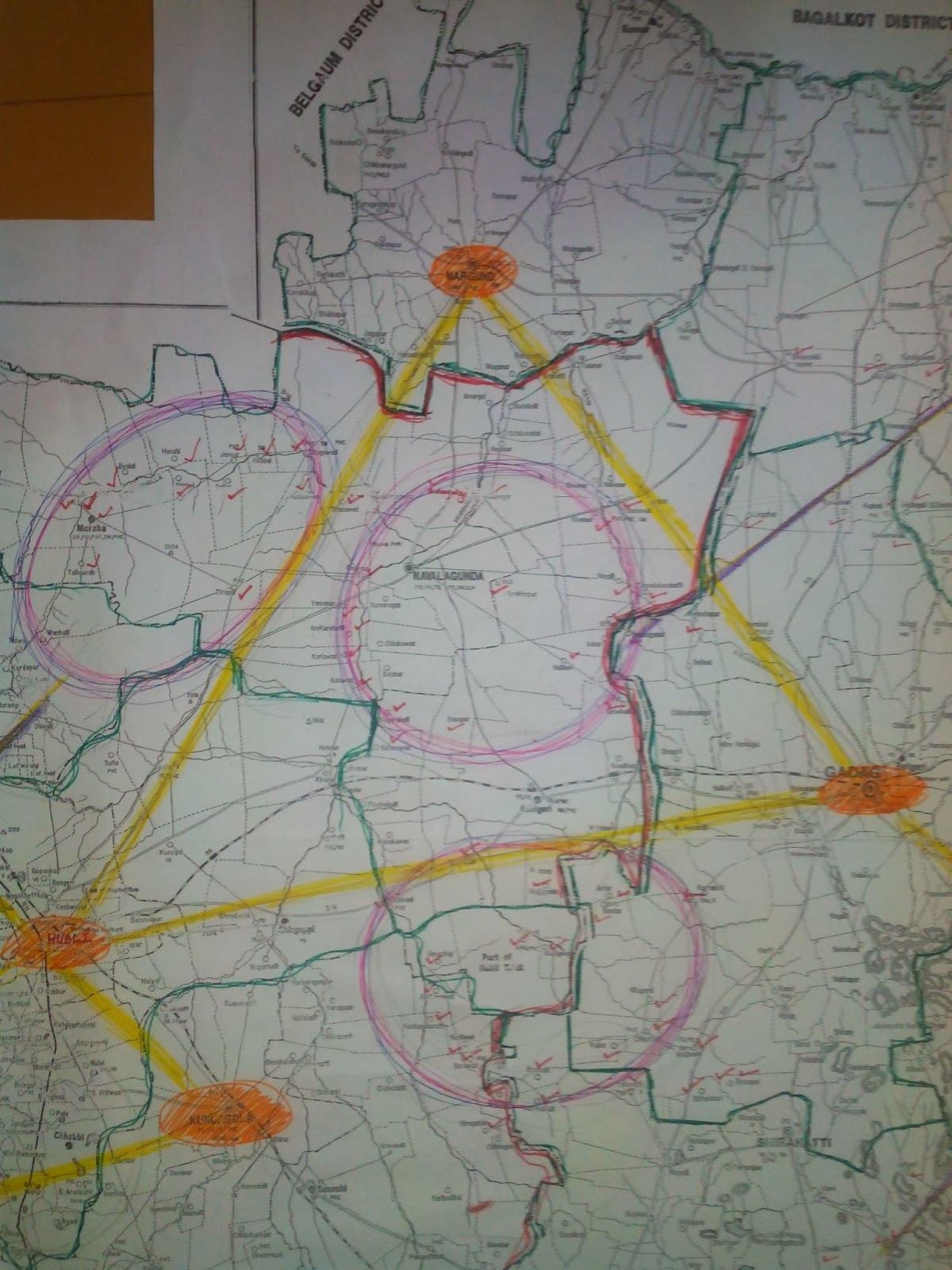
Once the village was identified on the Hard Copy of the Maps, they were
tallied with the latest Census List. Only the villages which existed in the
Census -2011 list were selected for further sampling. The following information
were collected from the Census -2011 list for the selected villages
- Total
Number of Households in every village
- Total
Population of the Village
- Total
Cultivator Population in the village.
Based on the above data the Outlier villages were dropped. The villages
with extremely low number of Households or Cultivator populations were dropped.
The villages were coded sequentially and a list of 190 villages was finalised
for the baseline study. These villages were also mapped on the Google Map,
creating a customized Map.
Whenever we plan to conduct a study in the remote villages, I am sure
many of us come across the complicated question of successfully locating the villages
where we plan to administer our survey. At times the administrative maps are
also not very helpful in identifying the exact location of these villages. Also
with time the government definition of the village boundaries change, which might
not be reflected in the block and district maps created years before the change.
To add to this the residents of the village who might not be very well aware
about such recent definition change may continue to mention a different village
name which can lead to mismatch of number villages in the sample. Though these
are unavoidable realities some ground level planning can be done to prepare a
list of the most updated village names. What is more important is the
identification of the village on the maps to verify the location which may be
important from the sample selection
point of view , like in the Price Information study.
The mapping is sometimes different as was observed when the field data
collection actually started. The villages which seemed to be just few
kilometres away (as seen on the Maps) from each other are actually separated by
uneven terrain, forests or water bodies because of which the road takes a
roundabout and longer route. The bigger challenge is the frequency of transport
to get to these villages which are at a great distance from the main
Blocks/Taluks. It will be interesting to see if the Farmers actually give up
the closest and most convenient markets where they have been regularly selling
and tread a road which takes them to a further but more profitable option.
Project page on CMF's website: http://bit.ly/1kBodE6
Comments
Post a Comment