
We continue our feature of the KGFS Impact Evaluation and follow from our previous post, which mentioned how KGFS researchers are customizing a harvest diary suited to the needs of the project.
In the last post on Designing a Harvest Diary, we shared a few valuable lessons we have been able to learn upon its
implementation. As of now, the harvest diary has been administered to farmers
in our pilot and will be maintained by them till January 2014. We will thus only
be able to completely assess its performance and data usability at the end of
the season. However, we have learnt a lot of valuable lessons already.
Overall, the response we’ve received from farmers has been
good, but the utility of the diary seems to be much greater for educated
farmers than uneducated ones. We found that even though farmers were literate
and could keep track of their expenses in the manner we required, they often
just had a mind block towards writing and chose to rely either on our surveyors
making revisits or on their children currently going to school to make an entry
on the diary. Farmers who had completed schooling or higher education found
this process more intuitive and were less inhibited to make an entry. We found
that the acceptance among farmers depended to a large extent on how well the
diary was explained to them and some of our surveyors did a better job of
putting respondents at ease than others. Since our ability to use this
instrument will also depend on the responsiveness and commitment of farmers to
the survey through the length of the season up to January, we have tried to
provide (in-kind) incentives for continuous compliance. The strength of these
incentives will only be revealed at the end of the pilot.
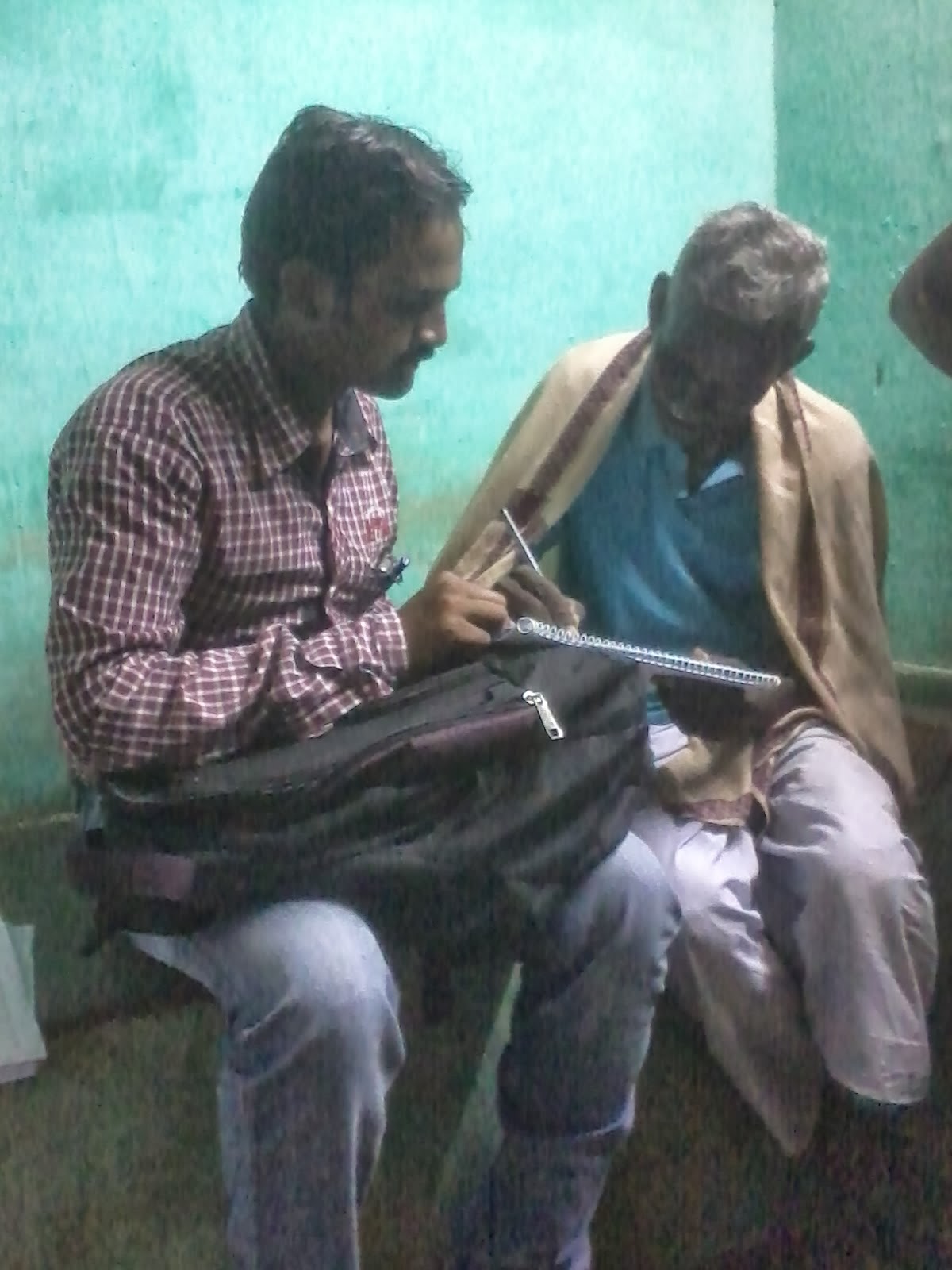 |
| A Surveyor Helping a Farmer fill a Harvest Diary |
From the feedback we have been able to observe, one area we
can do better in is providing a more comprehensive and approachable training on
the diary to respondents and setting up some sort of local automated group
monitoring system, whereby an educated individual can be available to regularly
assist those having difficulty with the diary. There is also tremendous scope
for improvement of the diary design itself to make it more appealing to
uneducated farmers. We will be using the experience from our pilot to identify
the greatest factors determining compliance and cost effective ways we can
reduce response difficulty and inhibition. There is also a need to
systematically compare the accuracy of self-reported information captured by
various survey instruments to audit for the efficiency of the follow up
instrument itself. Nevertheless, diary based surveying offers an exciting
prospect for future agriculture data collection and is one of the newest and
most interesting experiments for us at the KGFS Impact Evaluation Study.
Comments
Post a Comment