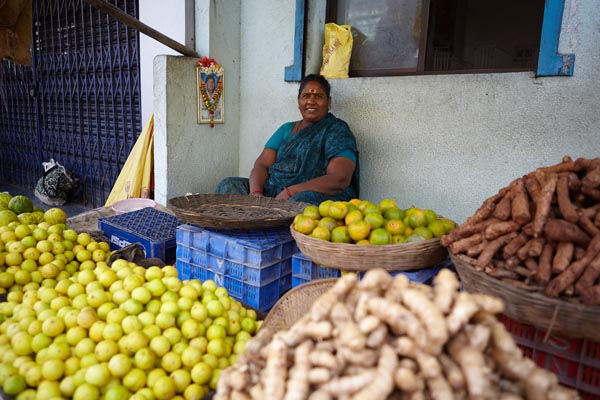
What is Livelihoods?
http://www.developmentoutlook.org/2013/07/what-is-livelihoods.html
Growth is the most pressing issue in a system, so
much so, that growth has become synonymous with success. Higher are the growth
figures bigger are the smiles that they incite, and so it should be, because
growing is nothing but expanding one's capacity. It is in this
light that we look at 'capacity building' as the fundamental agenda in every
system. However this idealistic agenda has a very dismal realization;
capacity building remains a hypothetical idea which has not seen much practical
manifestation and even if it has, the effects have not been sustainable and
equitable at the same time. This unbalanced frame encompassing non-sustainable
and inequitable growth is the reason why figures or quantitative measures
are not enough to assert that all population members have really expanded their
capacity, that each one of them leads a better life, has better access to
amenities and that each individual is better off. It is in this scenario that
the concept of livelihood comes in.
Livelihood, as an isolated term, is nothing but the
means of securing basic necessities of life, namely, food, water, shelter and
clothing. Any activity which helps an individual to secure his basic needs for
life is that individual's livelihood. For example, if a person catches fish and
sells them to earn money which in turn is used to procure food, shelter and
clothing, then fishing is the individual’s livelihood. Looking at the term
superficially, one can say that livelihood is an economic activity performed by
a person and this is the general form in which the word is usually used.

But there is more to livelihood than just eating, living and protecting oneself. After all the term does consist of “live” and “to live” is not the same as “to survive”. A person may catch fish but if he is not able to sell it then he cannot “live” from this activity. He might survive with what he has in his reach but that is his neural network forcing him to survive. In order to live he must derive the satisfaction from the activity and a fisherman can derive this satisfaction only when he gets a reasonable price for the fish he has caught. Thus livelihood also means an individual’s access to opportunity.
Now, considering an individual to be aloof of the
other population members around him would be an act of negligence because
social conditions are as important a factor in determining an individual’s
livelihood as is his skill set. A detailed analysis will show that society
plays a much greater role in a person's livelihood and hence it becomes
imperative to include social groups in our definition of the same. This is the
shared core idea of social capital “that social networks have value”. We thus
define livelihood as "the command an individual, family, or other social
group has over an income and/or bundles of resources that can be used or
exchanged to satisfy its needs. This may involve information, cultural
knowledge, social networks and legal rights as well as tools, land and other
physical resources." It is interesting to see how the change of
perspective has made the concept detailed but approachable at the same time. It
has brought terms like social group, resource bundle, information, cultural
knowledge, social networks and legal rights, to the drawing board. The
conglomeration of these gives us various starting points to observe, analyse
and attack the issues pertaining to livelihood.
In this new outlook, we no longer need to look into
the issues pertaining to each individual but rather we group them based on
certain criteria and observe the characteristic features of this group. Each
group has a specific resource bundle available to it, a certain amount of
exposure to information, definite cultural knowledge and a unique social
network. The idea of developing a group then becomes a matter of using these
exogenous variables to bring significant changes in the endogenous variables
and if viable alter the exogenous variables themselves to bring about
sustainable changes for the same.
In India, the rural areas are under developed and
lack organised systems for information transaction and even continue to suffer
in the clutches of social and gender discrimination. It is but obvious from the
above analysis that the rural areas have the majority of impoverished people
who struggle to earn their livelihood. The social backgrounds surrounding them,
makes the much practiced systems of status upliftment void. It was initially
suggested that if rural people are poor we should provide them with monetary
help or subsidies in kind or wealth to give them a better chance in the world.
However the widely practiced form of this assistance could not work largely due
to absence of collateral and illiteracy that plagues rural India and countries
similar to it.
Need is the father of invention and the need to provide financial
inclusion to these rural poor saw the emergence of micro finance as a solution.
Programmes were introduced to harness the innate capabilities of the poor and
to complement them with capacities in the form of information, knowledge,
skills, tools, finance and collectivization, so that they could participate in
the growing economy of the country. Improving livelihood is a holistic
development, one that would facilitate the poor to achieve increased access to
their rights, entitlements and public services, diversified risks and better
social indicators of empowerment. There are very few programmes that contribute
to human development the way livelihood programmes do and even few which are as
sustainable, which help them “live”.


Quoting definitions referenced in a Wikipedia entry deserves a reference to the Wiki http://en.wikipedia.org/wiki/Livelihood#cite_note-2.
ReplyDeleteLove Blaikie's work in general (look up The Political Economy of Soil Erosion - no neutrality in positions on soil erosion, cannot ignore larger political context etc.) so no harm using his definition but at least cite this right.