
The previous blog about
the ongoing project in Satara, “Economics and Psychology of Long Term Savings and Pensions” was an introduction to why
time-preference inconsistency is important and how it may manifest itself. The
current blog will attempt to describe how such a characteristic can be measured
in a survey and how it should be interpreted.
The classic survey methods to measure time
inconsistency (for example, see Ashraf, Karlan and Yin, 2006) involve hypothetical questions where a respondent is asked to
choose between a sum of money immediately and a slightly larger sum after a
period of time. The horizon for both these choices is short term. The response
is then compared with the same question asked with a longer time horizon (Table
1).
Table 1
Option
|
Now
|
Now + 1 week
|
Option
|
After 1 year
|
After 1 year + 1 week
|
|
1
|
Rs.100
|
Rs.110
|
1
|
Rs.100
|
Rs.110
|
|
2
|
Rs.100
|
Rs.120
|
2
|
Rs.100
|
Rs.120
|
|
3
|
Rs.100
|
Rs.130
|
3
|
Rs.100
|
Rs.130
|
|
4
|
Rs.100
|
Rs.140
|
4
|
Rs.100
|
Rs.140
|
|
5
|
Rs.100
|
Rs.150
|
5
|
Rs.100
|
Rs.150
|
Asking this question for marginally increasing
increments helps us figure out the rate at which respondents discount the
future. Our baseline data indicates that
out of 3305 respondents, 31 per cent are patient and two-thirds are impatient
(Figure 1). Only three per cent of the
sample shift (switch) their choices depending on the increment in the long run.
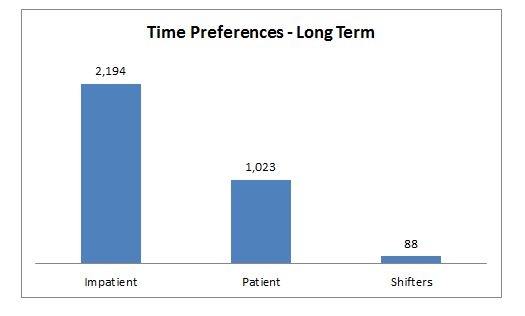
Figure 1
In the short run, however we find that 40 per cent are
patient and 52 per cent are impatient; with seven per cent being shifters
(Figure 2). We find that in the compared
to the long term horizon, a larger share of the sample are patient, a lower
share are impatient and the share of shifters/switchers more than doubles. The
differences in the responses to both questions are statistically significant, that
is, there are a significantly lower (higher) number of patient (impatient)
people in the long term.
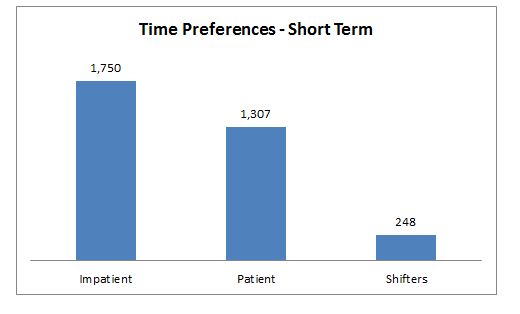
Figure 2
If a response
to each choice set in the short term is not the same as that in the long term
then he/she can be termed as “inconsistent” (roughly a quarter of our sample).
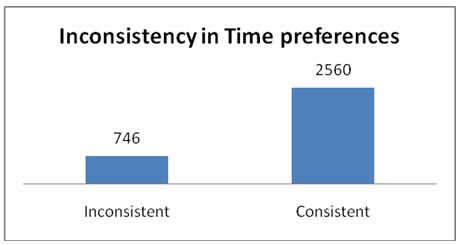
Figure 3
Hyperbolic discounters are those who are impatient in the short term and
patient in the long term and reverse-hyperbolic
discounters have just the opposite preferences. Consistent preferences
indicate that there is no change in responses across the two time horizons.
(See Figure 4 below)
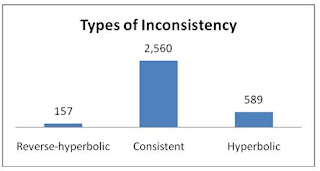
Figure 4
Theoretically, our techniques are not able to capture “preferences”, which are of course abstract, but they are capable of capturing “revealed preferences”. The underlying rationale for these choices, hence, becomes very important. Whether impatience is a result of impending current needs or uncertainty about the future is entirely different from the impatience that arises from a lack of self-control (Ameriks et al,2007).These are some of the interesting questions which will help us understand our respondents’ long term saving behavior.
Theoretically, our techniques are not able to capture “preferences”, which are of course abstract, but they are capable of capturing “revealed preferences”. The underlying rationale for these choices, hence, becomes very important. Whether impatience is a result of impending current needs or uncertainty about the future is entirely different from the impatience that arises from a lack of self-control (Ameriks et al,2007).These are some of the interesting questions which will help us understand our respondents’ long term saving behavior.
Comments
Post a Comment