
Qualitative Research: Something more than mere description
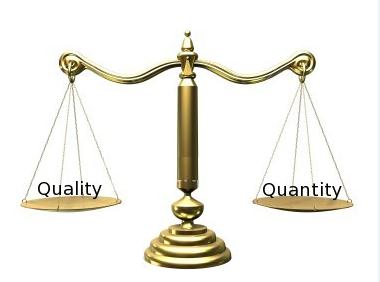
In our profession, we deploy both Quantitative and Qualitative research
methodologies. While both the methods have their own unique uses, that have
been widely documented, I have often observed that the former takes a
preference in case of a conflict. This could lead to an impression (albeit a
false one) in one’s mind that qualitative research is an amateur and less
“fashionable” research method and that any research design other than a quantitative
one is “non-experimental” and/or “weak”. In my opinion, this stereotyping is
both erroneous and simplistic. In addition, I believe it can also discourage
novice and budding researchers engaged in qualitative studies.
One of the reasons for this preference is simple enough - it is often easier to rely upon what can be measured as opposed to what can be proven. Another (and less obvious) reason is that while quantitative derivations use verifiable calculations, qualitative results often require experience and foresight, in addition to logic.
This post is an attempt to bring some of
the less known but important facets of the qualitative research
methodologies into a comparative analysis for a better understanding and
appreciation of both types of research methodologies. In this post, neither do
I wish to differentiate both research methods (Quantitative and Qualitative)
which are quite distinct in their own right, nor do I intend to challenge the
statistical and/or analytical merits of quantitative research. This is just a
fumbling first step in trying to provide some more context into what
goes into qualitative research and what makes it relevant. I will
leave it to the reader to delve deeper into the subject as they come across
more examples and practical experiences of qualitative research in their work.
Strong proponents of quantitative research may view
qualitative studies as ‘non-categorical’ and ‘less scientific’. Qualitative
studies, however, can also be categorical and methodical, even if the
methods used are relatively less acknowledged in the research
community. One of the key factors that prevent a reasonable analysis
and debate could be the lack of awareness regarding the array of
theoretically and technically sophisticated approaches in qualitative research
like Ethnography, Narrative Research, Phenomenology and Grounded
theory etc. Needless to say, I’m not including the case study
approach as it is widely used by both qualitative and quantitative research
practitioners.
I am summarising a few of these approaches below in
an attempt to provide the reader with a better understanding of the same.
Narrative
research - Focuses on an individual or small group’s story and
gives a chronological account of an event, action, experience or a series of
them.
Phenomenological study - Focuses on
psychological experiences of a concept, event, and/or phenomenon. It describes
the ‘lived experiences’ of a group and finds commonalities in the experiences
of individuals.
Grounded
theory - Focuses on social, organisational situations,
processes and generates a theory from data collected form participants who
experienced the process/event/action/interaction.
Ethnography - Studies a culture
sharing group and develops a portrait of the same. It is usually realistic,
critical and advocative.
As the reader may infer from this, qualitative
designs also have reasonable and well-considered combination of data collection
and analysis techniques. These ‘less acknowledged’ approaches yield valuable
results by using logical interpretation and analysis. While content analysis in
quantitative research applies pre-existing codes to the data, it is
data-derived in case of qualitative research.
Data Analysis in qualitative research involves
coding and theme development. Coding in qualitative research involves
marking segments with ideas, concepts and relevant points. Categorisation of
these codes develops themes. As the codes are generated from the data during
the course of the study, there is simultaneous collection and analysis of data
in qualitative research. Unlike quantitative research, content analysis of
qualitative studies involves not only the manifest of the data, it involves the
latent content of the data as well. Thus, qualitative research is more than a
mere description of events.
I hope I have been able to provide a very brief
flavour of the kind of rigour and methodical approach that is involved in
qualitative research as well. As an outcome of my developing understanding of
the value of qualitative research, I am of the opinion that claiming one
research method as easier, less desirable, less scientific or less valuable
than another is unreasonable.
Furthermore, I also believe that neither of the two
methods is absolutely weak or strong by definition. It is the purpose of the
study that defines and differentiates the usefulness and
appropriateness of the method used. In most instances, probably the best
strategy is to use “mixed methods research” that combines the strengths of both
the quantitative and qualitative research methodologies, thus complementing
each another to deliver optimal research outcomes.
In summation, it is critical to
re-discover and acknowledge the utility, relevance and significance of
qualitative research so that it finds its rightful place as a strong,
distinctive and valuable research technique.
Well written piece!
ReplyDelete