September 27, 2013

Stories from the field: The risks posed to our surveyors


During a survey operation, we conduct various surveys with our study participants, such as Household surveys, Vendor surveys, Market surveys and so on. Something we don’t think about however is that while surveying, the field staff, especially the surveyors take various risks to collect primary data. 

For example, we’re working in various villages on a study related to farming and the surveyors have to administer modules primarily related to land and farming. We also need to calculate a farmer’s land holding using a GPS device. Though this method is easy and approachable, it also has unforeseen risks.  

To calculate the land area, the surveyor needs to move around the boundary of the land and mark GPS records. The farming land and its surroundings are always covered with marshes, bushes and wild grasses or plants. Even walking through the land is really difficult due to it being covered with growing crops or grasses. During the harvest time - around September for our project, snakes and other poisonous insects are often found in these areas.

Now, when the surveyors collect the required GPS coordinates, they face the consequences of being bitten by, or being threatened by these creatures.

Recently, an incident took place where a surveyor was moving around a farmer’s land, got bitten by something, and fell on the ground shrieking with pain. He felt that he’d been bitten by snake. When the supervisor called him for a different location to check on the survey’s progress, the surveyor told him about the     incident.  We ran to the place to find the surveyor crying in pain and unable to walk - partly due to pain, and partly due to panic. 

Afterwards, we observed and realized that it wasn’t a snake bite but a bite by some other poisonous insect. He was taken to a medical center immediately and is doing better now. The incident was unnerving, firstly due to the fact that surveying has inherent risks for the staff, and secondly because such incidents create panic among the rest of the staff, who might disagree to do such work in the future.

For me, the most important reason for sharing this story is that when we analyze the survey data, output results, and present study findings to others, we don’t really take into account the risks faced by the staff. However, the surveyors are thankful for the career opportunities we’re able to provide, and this keeps them motivated.  

Sometimes, in our quest to get valuable primary data, we often forget about the hard work and risks faced by our surveyors. However, if we think about their work ethic and dedication, then we may realize how important these surveyors are to us. 

September 25, 2013

Stories from the field: Who are the poor? An experience with a community based approach

We feature a guest post from an intern on our livelihoods project, Jamie Toulze

Identification of the poor has always been more easily said than done. Many people consider the poverty line to be 1.25 USD per day, but can such an amount universally differentiate the poor from the rest of the population? And what about those that are just 10 cents above the poverty line? It’s increasingly common for global philanthropic institutions to proclaim decreasing poverty by x percent as their primary goal. However, is thinking of poverty as a level of income enough to determine who is poor and living in misery?  

The instinctive reaction is to look at income; however income alone misses many of the dimensions that make life ‘miserable’ as Harry Truman so adequately put it in his inaugural address which introduced the concept of underdevelopment. It was over 60 years ago that he declared people had the “knowledge and skill to relieve the suffering” of the poor. Yet, today we’re still having difficulty understanding what it means to be poor. Over the years, new methods have been introduced to capture all these dimensions, such as poverty score cards, proxy measure tests, consumption measures and a community approach. In this post, I will discuss my experience with one state in India’s experiment with a community based approach.

Over the last 5 years, the government of Tamil Nadu, India in conjunction with the World Bank has implemented a community based method to identify their own poor. This method is called the Participatory Identification of the Poor (PIP) process and falls under the Pudhu Vaazhu Project in Tamil Nadu. In addition to having the villagers classify themselves as poor or not, the PIP process goes a step further than just identifying the poor by creating a Village Poverty Reduction Committee (VPRC). This committee is made up of 10-15 women from the poorest of the poor households as well as under-represented demographics such as scheduled tribes or castes, youth and the disabled. This committee not only identifies the poorest of the poor but also determines the interventions that will be used to assist these vulnerable households.

Over the course of my fieldwork, I managed to go to several villages and ask about this process and how satisfied the villagers were with the program. I have to admit that when I first saw the video on the PIP process it was hard for me not to be skeptical. It seems to be a long and arduous process with far too many steps for the villages to be carrying them out as planned.

However, on the field I was surprised to see that is exactly what was happening. I observed the process of creating the VPRC, which was step-by-step just as the video showed and I was able to ask some beneficiaries of the VPRC about their aid. Everyone I spoke to informed me that they were getting employed after receiving training or knew of people who had and that the disabled were being assisted where they once had been over looked. It seemed that by engaging the communities in their own assistance, people were much happier and satisfied with what was being done. When asked to rank all the government schemes, the villagers who knew of the PIP process and VPRC ranked it as number one.

In addition to what I've seen of Tamil Nadu’s community based approach, there was also a study by JPAL which compared several models of poverty identification. The results state that while community methods were less accurate than proxy means tests in identifying people who lived on less than 2 dollars a day, community members were more satisfied with the community based approach. This goes to show that poverty is multidimensional and that income alone does not fully capture those who are living in misery. While restricting a target or goal to very identifiable measures (such as income) is easier and more manageable for companies and countries to work towards, it's less inclusive and beneficial in the eyes of the community members. 


This year, the World Bank’s president Jim Young Kim set a goal of eliminating extreme poverty by 2030. Based on today’s measurements of income this goal is possible however, even if we reach this goal, the world will be far from having eliminated those ‘living in misery’. Poverty is more than a number, it is a condition of living and those that are living it are the best suited to identify themselves, as the government of Tamil Nadu and PAC have both found. While we might be a bit slower than Harry Truman would have thought, I believe we are gaining better knowledge on how to pull people out of misery.


____________________________________________________

Jamie Toulze is a second year master's student at University of California San Diego's International Relations, Pacific Studies program (IR/PS). She is studying public policy and joined CMF over the summer to better understand development research. Previously, she received her bachelors from the University of California Santa Cruz in anthropology and worked for the military and as a teacher overseas.


Some further recommended reading on the subject:


September 23, 2013

State-Wise Database of Government Welfare Schemes


Recently, the Livelihoods Initiative at CMF compiled a comprehensive database of government welfare schemes that focus on livelihoods promotion, such as social security,  health and education, broken down by state. This list is available on their project page here as an excel file. 

Given the increased focus on the livelihoods sector through the NRLM and several state level missions, there is a large demand for the documentation of all the major livelihoods promotion activities. This compilation of government schemes is CMF's Livelihoods Missions contribution in meeting that demand. The objective is to assist in knowledge transfer and information flow, to move beyond the re-creation of the same wheel in several different regions, to a more structured and direct approach to livelihoods promotion across the country, through greater collaboration. 

The list is updated as of August 2013, but subject to change as new schemes are introduced and old ones phased out.

September 18, 2013

Access is not enough

There has been a lot in the news lately about financial inclusion and extending banking services to the poor. With the expansion of the Aadhaar registration and new initiatives like the Financial Access at Birth (FAB), it seems that a lot more people will be brought under the umbrella of formal banking in the near future. The RBI governor, Raghuram Rajan has included it as part of his agenda in his inaugural speech as well. This is great news. However, what is conspicuous by its absence in this discussion is talk of financial literacy.

Taking the example of the ongoing study in Maharashtra on pensions, our sample of around 3000 respondents all have access to formal banking. They are all either current or recent account holders of some sort of financial product (short-term savings, recurring deposits or loans). While the level of ability in elementary math is fairly good, the level of financial ability is not. Respondents were asked to answer questions on simple addition, subtraction and multiplication as well as questions regarding simple and compound interest. The understanding of how simple interest is calculated is clear among half of the sample but only 4% of the sample was able to correctly answer compound interest questions (See table below).  
   
Question
% of correct responses
Sample Size
Addition  (81+24)
79%
3059
Subtraction (20-13)
91%
3059
Multiplication (5*12)
85%
3059
How much is Rs.100 worth after 1 year with 10% simple interest calculated annually?
58%
3059
How much is Rs.100 worth after 5 years with 10% simple interest calculated annually?
48%
3059
How much is Rs.100 worth after 1 year with 10% compound interest calculated annually?
4%
3059
How much is Rs.100 worth after 5 years with 10% compound interest calculated annually?
4%
3059
                                                       
                                                                   Table 1. Financial Ability Results

In a scenario where financial operations are becoming easier and more accessible, it is all the more important that customers are able to comprehend them and use them to their advantage. A pension product is not very complex but it is definitely more sophisticated than savings accounts. With asset values linked to the market and varied risk compositions, customers need to be pretty savvy to know when to withdraw their savings or when to invest more. The adult literacy initiatives (conducted by local banks and societies) seem to be limited to preaching that “savings is good while borrowing is bad”. With a wider range of products on offer, we need to broaden the scope and reach of financial education lest all the inclusion be in vain.  

September 12, 2013

India Place Finder - A cutting edge GIS tool

A cutting edge geographic information system tool to track the Indian diaspora has been developed by Dr. Tsukasa Mizushima, a professor at Tokyo University. Dr. Mizushima and his colleagues have developed the "India Place Finder", a web-based application that allows researchers to find geographic information about any place (known as toponym) in India. All places listed in the 2001 Census of India can be found via this tool.

Why is the tool useful to researchers?
Researchers can query a place by either sorting through the list, or narrowing the results by the State, District, or Sub-District. This might sound a lot like Google maps - but it offers more. The tool provides comprehensive topological context to a place, reaching back to 18th century India until 2001.

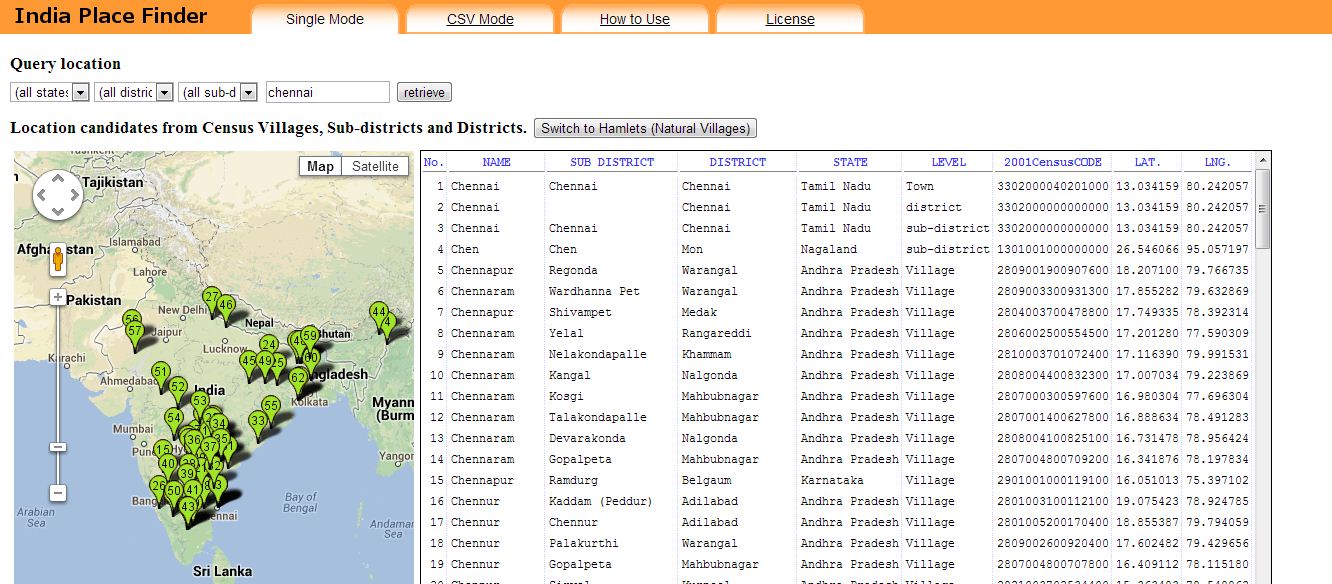
For example, if you search for “Chennai”, the tool shows all matches for Chennai within India, both on a grid (with State, District, Sub-District, Census Code, Latitude, and Longitude) and a map. In addition, all notation fluctuations are also considered and therefore, other places similar to Chennai appear in the results; in this case places like Chenai, Chen and so on also appear on the grid and on the map. Upon zooming into any location, you can find a detailed satellite or topological map.

Courtesy: India Place Finder (http://india.csis.u-tokyo.ac.jp/)

So far, 900,000 villages have been included. Researchers can now track relatively obscure places on the maps with exact coordinates, prior to conducting field work. The tool is free to use, and easy to operate. The tool can be used to search one place at a time (Single Mode), or multiple places at a time (CSV Mode).

Information from Census 2001 and 4,500 Survey of India topological maps from 1869 onward have been used to create this vast database. The Government of India restricts the usage of Survey of India maps and the digital framework around Census information. Thus in order to make the map more comprehensive, Dr. Mizushima worked with libraries and with open data sources to develop these maps. For instance, Census 2001 district handbooks were used to map the villages that appear on the tool.
_____________________________________

Dr. Mizushima is currently a professor of South Asian History at the Graduate School of Humanities and Sociology at Tokyo University, and specializes in the Indian geographic and demographic history

September 9, 2013

Great Expectations for the Financial Inclusion Agenda


We feature a guest post from Amy Jensen Mowl, a faculty researcher at the Institute for Financial Management and Research. 

Even in an environment of great expectations, new RBI Governor Raghuram Rajan’s opening statement was remarkable for its ambition and clarity of purpose.  His speech deserves the widespread praise it has received.  It should also be lauded for its unexpected and overdue move to make financial inclusion an economic policy priority.

As the current account deficit, inflation, growth rate, and currency indicators have deteriorated, the issue of financial inclusion has moved aside in debates over optimal policy.  Yet despite sustained financial inclusion efforts since 2005, less than 35% of Indian adults presently have an account with a formal financial institution, and less than 12% saved in the past year. And despite India’s savings and investment as a percentage of GDP rising above 30%, a mere 11% of India’s households are classified as investor households.  Today, the majority of India’s savings is locked into physical assets such as gold, property, and business assets, and locked out of India’s financial markets.

Unfortunately, some of the recent policy rhetoric has placed the blame on households for the current economic turmoil. In particular, many voices have argued that demand for gold was the primary cause of currency depreciation and current account deficit.  By mid-August, as the government imposed a series of increasingly restrictive controls on gold imports, one might be forgiven for mistaking certain articles in the popular press with parody.  Yet rather than being irrational or speculative, household demand for gold is exposing a systemic weakness Mr. Rajan laid bare in his statement: lack of access to financial alternatives.

For example, recent research by the NSE and IFMR reveals that acquiring even a simple financial asset—a savings deposit account—imposes substantial obstacles to the average customer. From a detailed study of the hidden costs to open bank accounts, three key findings emerged:

  • First, individuals incurred multiple out-of pocket expenses in opening simple deposit accounts. These non-bank fees for transportation, photocopies, and other incidental expenses range from an average of Rs.100-200. 
  • Second, opening an account involved a significant time commitment.   The typical person spent between 8-13 hours, across an average of two visits, before a simple deposit account was opened.  
  • Third, documentation and paperwork requirements were the dominant factors in both out of pocket expenses and time spent to open an account.  In addition, documentation requirements were vague and inconsistent across urban and rural banks: while nearly all banks required at least three forms of documentation, more than half of all urban accounts required individuals to provide five or more forms of documentation.
This data and other ongoing financial inclusion research demonstrates that persistent demand for gold and other non-financial assets is a symptom of the deeper problem: despite nearly a decade of policy reform to promote financial inclusion, formal financial access is an expensive and inconvenient proposition for the majority of Indian households.

Thankfully, Mr. Rajan was an early champion of the idea that broad access to finance was central to economic growth, stating “financial sector reform is both a moral and an economic imperative.” As Chairman of the Committee on Financial Sector Reforms, his 2009 report, A Hundred Small Steps, laid out a comprehensive agenda to improve access to finance. India is now bearing the costs of not tackling financial inclusion reforms sooner.

Yesterday’s statement identified a number of concrete areas for work, all of which are sensible, and none of which will be easy.  The focus on SME lending, and the importance of promoting access to financial assets—which offer the only true protection from inflation—were especially welcome.

If Wednesday’s speech is an indication of what to expect over the next three years, the financial inclusion agenda will be treated as it should be: as a national economic priority.

_____________________________________________

Amy Jensen Mowl currently leads the Yale EGC-CMF Tamil NaduSocioeconomic Mobility Survey (www.tnsms.org), an ongoing, long-term panel study of 10,000 urban and rural households.

Ms. Mowl holds a Master's Degree in Public Administration and International Development from Harvard University’s Kennedy School of Government, where she served as a research assistant for courses in political and economic development.  She holds a BA in economics from the University of California. Her research interests include household economic behavior and the causes and consequences of socio-economic mobility.